
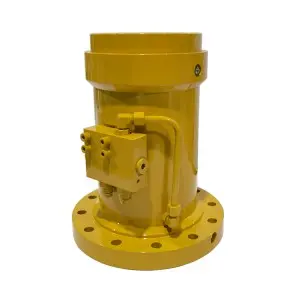
A front flange hydraulic rotary actuator provides a mechanical interface for integrating hydraulic rotary motion into machinery and equipment structures. In applications such as attachment rotation, boom positioning, conveyor adjustment, and industrial handling, the mounting arrangement influences far more than the actuator’s installation position.
Two hydraulic rotary actuators with similar torque ratings may produce the same rotational movement but transfer mechanical loads into the surrounding structure differently. Understanding this relationship reveals why front flange mounting can be valuable in equipment requiring compact integration and substantial rotary output.
The Mounting Interface Is Part of the Transmission System
A rotary actuator generates torque that must be transferred to a moving mechanical component. At the same time, an opposing reaction torque acts on the actuator housing and its supporting structure.The mounting interface provides the connection through which this reaction is transferred into the machine. Its position and geometry influence how the actuator interacts with the equipment frame, attachment, and other structural components.
A front flange mounting arrangement typically allows the actuator housing to be secured through a flange located near the output side. The rotating output member then connects to the component requiring angular movement.
These two interfaces must be distinguished. A front output flange transmits rotation to the driven component, while a stationary mounting flange connects the actuator housing to the supporting structure. Product drawings identify their respective positions and functions.In machinery with restricted installation space, the arrangement of these interfaces can significantly influence how the rotary mechanism is designed.
Front Flange, Rear Flange, and Foot Mounting Compared
Hydraulic rotary actuators are available with different mounting configurations. Although each arrangement can support rotary movement, their mechanical integration characteristics differ.
|
Comparison |
Front Flange Mounting |
Rear Flange Mounting |
Foot Mounting |
|
Mounting position |
Near the output end |
Toward the rear of the actuator |
Along the actuator housing |
|
Structural connection |
End-mounted supporting plate |
Rear supporting structure |
Supporting base or equipment frame |
|
Equipment layout |
Suitable for direct end integration |
Suitable for rear-supported arrangements |
Suitable for base-mounted mechanisms |
|
Space considerations |
Can simplify output-side integration |
Requires suitable rear support |
Requires space beneath or beside the housing |
|
Typical design priority |
Compact rotary connection |
Rear structural integration |
Flexible base installation |
The choice depends on the surrounding machine geometry rather than torque capacity alone.
For example, a rotating mechanism installed through a structural plate may benefit from an end-mounted configuration. A mechanism positioned above a machine chassis may instead be more compatible with foot mounting.
The actuator’s mounting position establishes how mechanical loads enter the supporting structure, making it an important element of the complete equipment design.
What Happens When a Rotating Attachment Carries an Offset Load?
Consider a hydraulic rotary actuator connected to a positioning arm carrying a heavy attachment. The actuator must generate rotational torque, but the attachment also applies additional mechanical forces through its weight and position.
If the attachment’s center of gravity is located away from the supporting interface, its weight creates an overturning moment. This loading condition is different from the torque required to rotate the attachment around the actuator axis.
Increasing the distance between the attachment and its supporting interface can increase the bending moment, even when attachment weight remains unchanged.
For example, an idealized 1,000 N external force acting at a perpendicular distance of 0.3 m creates a moment of 300 Nm. Increasing this distance to 0.6 m doubles the moment to 600 Nm.
This illustrates why mounting geometry influences actuator loading independently of hydraulic output. A front flange arrangement may help reduce unnecessary structural offsets in suitable equipment designs, although actual moment capacity depends on the complete actuator and support configuration.
Understanding the Different Loads Acting on a Rotary Actuator
Rotary actuator specifications often include several load capacity parameters. Each represents a different mechanical demand placed on the actuator assembly.
Drive Torque
Drive torque represents the rotational force generated by the actuator under specified hydraulic operating conditions. It determines the actuator’s ability to move the connected mechanism against resistance.
Radial Load
Radial loads act perpendicular to the rotation axis. The weight of a horizontally mounted attachment or external working forces can produce this type of loading, which must be supported by the actuator’s bearing system and surrounding structure.
Axial Load
Axial loads act parallel to the rotation axis. These forces may occur in vertically oriented mechanisms or equipment where external forces are transferred along the actuator shaft.
Moment Load
Moment loading occurs when external forces act at a distance from the supporting interface. It can place substantial demands on bearings, housings, mounting connections, and the connected mechanical structure.
These parameters describe different aspects of mechanical capacity. An actuator with sufficient drive torque does not automatically possess sufficient radial, axial, or moment capacity for every attachment configuration.
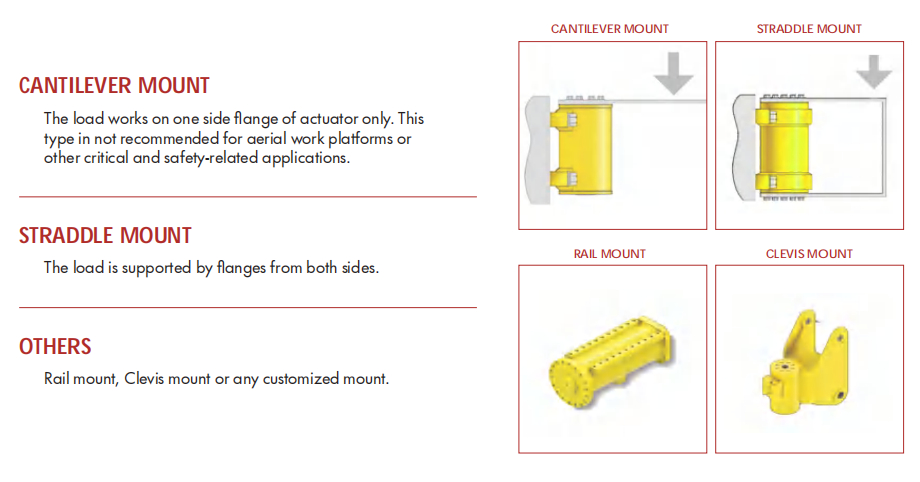
Cantilever and Straddle Support: Two Different Structural Arrangements
A cantilever-mounted mechanism supports the load primarily from one side. This arrangement can simplify equipment construction and provide unobstructed access to the rotating component.
However, when the load extends away from the supporting interface, its weight and external working forces can generate considerable bending moments. Longer attachments or offset structures may increase this mechanical demand.
A straddle-supported arrangement places supporting structures on both sides of the rotating mechanism. Depending on the equipment geometry and bearing configuration, this can distribute external loads differently and reduce some of the demands associated with unsupported overhang.
Certain hydraulic rotary actuators provide output configurations suitable for these different arrangements. A single output flange may accommodate a one-sided connection, while double output flanges can support equipment designs requiring connections on both sides.
The appropriate arrangement depends on the actuator’s published load capacities and the surrounding structural design. Double flange output does not automatically create a higher allowable load unless the complete support arrangement is designed accordingly.
Why Front Flange Mounting Can Simplify Machinery Integration
Traditional rotary mechanisms may use a combination of hydraulic cylinders, external linkages, pivot shafts, and supporting brackets to convert linear movement into angular movement.
These arrangements can be effective, particularly when the mechanism requires a specialized movement path or changing mechanical advantage. However, the additional components may occupy considerable space around the rotation axis.
A helical hydraulic rotary actuator generates angular movement through an internal piston and helical transmission mechanism. This arrangement can combine hydraulic actuation and rotary output within a single assembly.
When combined with front flange mounting, the actuator can be integrated directly into suitable supporting structures, potentially reducing the need for external transmission components.
For OEM machinery manufacturers, this creates several design possibilities:
● Reducing the space occupied by external rotary transmission mechanisms.
● Positioning the actuator close to the driven component.
● Simplifying suitable structural interfaces between the actuator and attachment.
● Accommodating equipment designs with limited installation space around the rotation axis.
These advantages depend on the equipment configuration, available structural support, and required load capacity.
Applications That Benefit From Front Flange Integration
Rather than being restricted to one industry, front flange hydraulic rotary actuators are particularly relevant to equipment with specific mechanical integration requirements.
In construction machinery, an actuator may be incorporated into an attachment positioning mechanism where available space around the working tool is limited. A flange-based connection can provide a compact interface between the actuator and rotating assembly.
Industrial material handling equipment may also benefit from this arrangement. Rotating arms, positioning fixtures, and equipment handling mechanisms often require angular movement around a defined axis while maintaining an unobstructed surrounding workspace.
Marine equipment presents another potential application. Davits, access mechanisms, and positioning systems may require rotary movement within specialized supporting structures. The mounting configuration must be considered alongside environmental exposure, load conditions, and applicable equipment requirements.
Specialized vehicles can also use flange-mounted rotary actuators for positioning working attachments, adjustable mechanical structures, or other functions requiring limited-angle rotation.
WEITAI Front Flange Hydraulic Rotary Actuators
WEITAI provides helical hydraulic rotary actuators for mobile machinery, industrial equipment, construction attachments, and specialized mechanical positioning systems.
Its flange-mounted rotary actuator range includes configurations with different output arrangements and mounting options. The WL30 series, for example, offers front and rear flange mounting configurations, as well as single front flange and double flange output options on selected products.
This flexibility allows equipment manufacturers to evaluate different structural arrangements rather than redesigning the complete mechanism around one mounting type.
The series covers a range of drive torque capacities and offers 180° and 360° rotation configurations. Selected products also provide optional counterbalance valves for applications requiring additional hydraulic load control.
WEITAI publishes drive torque, holding torque, radial capacity, axial capacity, and moment capacity data for individual configurations. These parameters provide a technical basis for evaluating the actuator’s compatibility with both hydraulic requirements and mechanical loading conditions.
From Existing Mounting Drawings to an OEM Rotary Solution
For equipment manufacturers, the mechanical interface often determines whether a rotary actuator can be integrated into an existing product platform.
WEITAI supports OEM applications requiring specific mounting configurations, output arrangements, rotation angles, and hydraulic operating characteristics. Its product range also provides options for replacement projects involving existing flange-mounted hydraulic rotary actuators.
The front flange hydraulic rotary actuator price depends on torque capacity, rotation range, output configuration, mounting arrangement, hydraulic control options, and purchase quantity.
As a hydraulic rotary actuator manufacturer and supplier in China, WEITAI provides product matching, OEM application support, replacement evaluation, and wholesale supply for international machinery manufacturers and distributors.
If you are looking to buy a front flange hydraulic rotary actuator, submit the required torque, external load conditions, mounting drawings, hydraulic pressure, and rotation angle to WEITAI for product evaluation and quotation.
FAQ
Is a front flange output the same as front flange mounting?
No. The output flange connects to the rotating mechanism, while the mounting flange secures the actuator housing to the supporting structure. Their positions and functions are defined in the product drawings.
Can a front flange hydraulic rotary actuator provide continuous rotation?
Not necessarily. Many helical hydraulic rotary actuators are designed for a defined angular movement, such as 180° or 360°. A specified 360° rotation range does not automatically indicate unlimited continuous rotation.
Can WEITAI provide replacement flange-mounted rotary actuators?
WEITAI supports replacement inquiries based on existing actuator specifications, mounting dimensions, rotation requirements, and mechanical load capacities. Compatibility depends on the selected product configuration and equipment requirements.
Post time: Nov-27-2026