
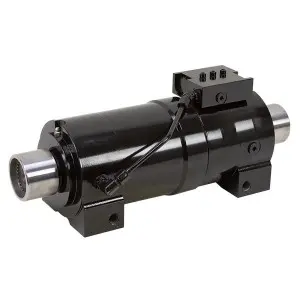
A Hydraulic Rotary Actuator is a hydraulic component designed to convert hydraulic pressure into controlled rotary movement with high torque output. Unlike a traditional hydraulic motor system that often requires additional gear reducers, brakes, and external transmission components, a Hydraulic Rotary Actuator integrates the driving mechanism and rotary structure into one compact unit.
For construction machinery, mobile equipment, and industrial systems, a Hydraulic Rotary Actuator provides more than simple rotation. It helps equipment achieve controlled angle movement, stable positioning under load, and reliable operation in environments with vibration, dust, and changing working conditions.
When traditional rotation solutions become too complex, too large, or difficult to control, a Hydraulic Rotary Actuator offers a more integrated approach by combining torque generation and rotary control in a single hydraulic solution.
Why Hydraulic Rotary Actuator Is Different from Traditional Rotary Systems
A hydraulic motor can provide continuous rotary power, which makes it suitable for applications that require constant rotation.
However, many machines do not operate this way.
In construction equipment, attachments, and handling systems, rotation usually happens in cycles:
- Rotate to a working position;
- Hold the position under load;
- Adjust the angle during operation;
- Return or rotate to another position.
These movements require more than simple rotation speed.
The machine also needs:
- High starting torque;
- Stable movement at low speed;
- Accurate position control;
- Resistance to external loads.
A traditional hydraulic motor system may require additional components to achieve these functions. The added gearbox, braking mechanism, and mounting structure increase system complexity and require more installation space.
A hydraulic rotary actuator combines the torque transmission mechanism and rotary function into one compact structure, making the overall system easier to integrate.
High Torque Output in Limited Installation Space
One of the biggest challenges in mobile machinery is the relationship between available space and required force.
Many machines have limited room around:
- Attachments;
- Boom structures;
- Frames;
- Rotating joints;
- Hydraulic connections.
At the same time, the rotating mechanism may need to handle heavy loads.
A helical hydraulic rotary actuator solves this challenge by using a mechanical conversion structure that transforms linear hydraulic movement into rotary output.
This design allows the actuator to achieve high torque density, meaning more rotational force can be produced from a relatively compact body.
For equipment designers, this provides several advantages:
- Reduced installation space;
- Fewer external transmission parts;
- Simplified mechanical layout;
- Easier integration into existing structures.
The goal is not simply to create more torque, but to deliver the required torque without making the machine larger and more complicated.
Why Low-Speed Control Is Important in Real Equipment
Many rotary applications do not require maximum rotation speed.
In fact, excessive speed can create problems.
When an attachment carries a heavy load, fast rotation may cause:
- Unstable movement;
- Difficult positioning;
- Increased impact when stopping;
- Higher stress on mechanical connections.
A hydraulic rotary actuator provides controlled rotary movement, allowing equipment to operate smoothly even when precise positioning is required.
This is especially important for machinery that needs operators to adjust angles frequently during work.
Examples include:
- Rotating excavator attachments;
- Material handling mechanisms;
- Positioning equipment;
- Specialized construction tools.
In these situations, controlled movement is often more valuable than maximum speed.
Maintaining Stable Position Under Changing Loads
A major challenge in rotary systems is maintaining stable movement when external forces change.
A rotating component may experience different resistance levels depending on:
- Material weight;
- Ground conditions;
- Working direction;
- Mechanical contact.
For example, an attachment may rotate easily without load but require much higher torque when working against resistance.
A properly matched hydraulic rotary actuator helps maintain stable output during these changing conditions.
This improves:
- Operating consistency;
- Positioning accuracy;
- Equipment control;
- Working reliability.
For heavy machinery, stable performance under changing loads is often a more important measurement than peak torque alone.
Reducing Mechanical Complexity Through Integration
Machine design often involves balancing performance with simplicity.
A traditional rotary system may require several independent components:
- Hydraulic motor;
- Gear reduction unit;
- Brake system;
- Coupling components;
- Additional mounting structures.
Each additional component increases:
- Installation difficulty;
- Potential failure points;
- Maintenance requirements;
- Space requirements.
An integrated hydraulic rotary actuator reduces the number of external components required.
This can simplify equipment design and create a cleaner hydraulic and mechanical layout.
For manufacturers and equipment users, fewer components often mean easier maintenance and more predictable operation.
Reliability Under Heavy-Duty Working Conditions
Hydraulic rotary actuators used in construction and mobile equipment usually operate under demanding conditions.
Typical challenges include:
- Continuous vibration;
- Dust and contamination;
- Shock loading;
- Frequent operating cycles;
- Outdoor exposure.
Long-term reliability depends on more than torque capability.
Important factors include:
Internal sealing performance
Seals must maintain hydraulic efficiency while handling repeated movement.
Bearing and support structure
The internal support system must withstand external loads and maintain smooth rotation.
Structural strength
The actuator body must handle repeated torque output without deformation.
Manufacturing accuracy
Precision machining affects efficiency, wear, and operating stability.
A high-quality rotary actuator should maintain consistent performance throughout long working cycles rather than only meeting initial performance requirements.
Important Considerations When Selecting a Hydraulic Rotary Actuator
Choosing a Hydraulic Rotary Actuator requires a complete understanding of the machine working conditions.
Important factors include:
Required torque
The actuator should provide enough torque for normal operation while considering possible impact loads.
Rotation range
Different machines may require limited-angle rotation, repeated positioning, or specific working angles.
Installation dimensions
The actuator must match available space, mounting structure, and hydraulic connection layout.
Working frequency
Equipment with frequent rotation requires better durability and thermal management.
External mechanical loads
Side forces, vibration, and impact can influence service life.
The correct actuator is not always the one with the highest torque rating. It is the one that matches the complete mechanical and hydraulic system.
WEITAI Hydraulic Rotary Actuator
WEITAI hydraulic rotary actuators are designed for equipment requiring compact installation, high torque output, and reliable rotary control.
The helical hydraulic rotary actuator series provides a practical solution for construction machinery attachments, material handling equipment, and other mobile hydraulic systems where controlled rotation is required.
With integrated mechanical design and durable hydraulic performance, WEITAI rotary actuators help simplify machine structures while providing stable rotation performance in demanding working conditions.
Frequently Asked Questions
What is the main difference between a hydraulic rotary actuator and a hydraulic motor?
A hydraulic motor is mainly designed for continuous rotation, while a hydraulic rotary actuator is better suited for controlled rotation, high torque output, and positioning applications.
Why are hydraulic rotary actuators suitable for heavy equipment?
They provide high torque in a compact structure and can operate reliably under changing loads, vibration, and frequent working cycles.
What factors affect hydraulic rotary actuator selection?
Torque requirement, rotation angle, installation space, operating frequency, and external mechanical loads should all be considered.
Can a rotary actuator replace a hydraulic motor system?
In applications requiring controlled angle rotation and stable positioning, a rotary actuator can simplify the system compared with a traditional hydraulic motor solution.
Post time: Aug-20-2026