
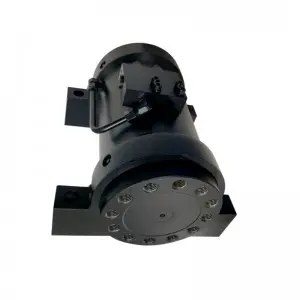
A Hydraulic Rotary Actuator with 180° and 360° rotation may share the same torque rating, but the two configurations can behave very differently in a machine.
For the referenced configuration, increasing rotation from 180° to 360° doubles hydraulic displacement from 3,540 cc to 7,080 cc and increases overall actuator length from 524 mm to 776 mm, while the listed drive torque remains 14,000 Nm and holding torque remains 35,000 Nm.
This shows why rotation angle should not be treated as an isolated specification. It directly affects hydraulic oil demand, installation space, cycle time, and the way the actuator fits into the machine structure.
Key 180° vs 360° Hydraulic Rotary Actuator Data
| Parameter | 180° Configuration | 360° Configuration |
|---|---|---|
| Drive Torque | 14,000 Nm | 14,000 Nm |
| Holding Torque | 35,000 Nm | 35,000 Nm |
| Displacement | 3,540 cc | 7,080 cc |
| Overall Length | 524 mm | 776 mm |
| Mounting Length | 400 mm | 652 mm |
The most important point is that more rotation does not automatically mean more torque. In this configuration, the torque ratings remain unchanged, while displacement and actuator length increase substantially.
Rotation Angle Changes Hydraulic Demand
A 360° actuator has to complete twice the angular travel of a 180° version.
In the referenced configuration, this doubles displacement from 3,540 cc to 7,080 cc.
Displacement matters because it determines how much hydraulic oil must pass through the actuator to complete the movement. If machine flow stays the same, the higher-displacement actuator requires more time to complete its full rotation.
The relationship can be summarized simply:
Rotation angle determines travel distance, displacement determines oil volume, and hydraulic flow determines movement speed.
This distinction is important when integrating a rotary actuator into an existing hydraulic system.
If available flow is too low, the actuator may still produce sufficient torque but rotate more slowly than expected. Increasing flow can reduce cycle time, but excessive flow may make precise positioning more difficult.
For machines that require controlled positioning rather than continuous high-speed rotation, the goal is therefore not maximum flow. The goal is enough flow to achieve a practical cycle time while maintaining smooth control.
Rotation Angle Also Changes Installation Geometry
The difference between 180° and 360° is also visible in physical size.
The overall length increases from 524 mm to 776 mm, while mounting length increases from 400 mm to 652 mm.
This matters on mobile and industrial machinery where hydraulic components often compete for limited installation space with structural frames, hoses, bearings, attachments, and other mechanisms.
A machine may have enough radial space for the rotary output but insufficient axial space for the longer actuator body.
This gives a practical design rule:
Required rotation should be defined before the surrounding machine structure is finalized.
Selecting 360° simply because it offers more movement can create unnecessary packaging problems when the application only requires limited angular travel.
In applications such as folding mechanisms, doors, positioning arms, and attachment rotation, 180° may already cover the complete working envelope.
Drive Torque and Holding Torque Describe Different Conditions
The referenced actuator provides 14,000 Nm of drive torque and 35,000 Nm of holding torque.
These values should not be interpreted as interchangeable.
Drive torque describes the actuator’s ability to rotate the connected mechanism.
Holding torque describes its ability to resist unwanted rotation after movement stops.
Holding torque becomes particularly important when the connected load remains exposed to gravity, machine movement, material resistance, or an offset center of gravity.
Typical examples include:
- Material-handling arms
- Agricultural mechanisms
- Mining equipment
- Truck and trailer systems
- Heavy positioning structures
- Marine machinery
A mechanism can rotate successfully under hydraulic power but still require much higher resistance once it reaches its working position.
For this reason, applications that hold an offset or suspended load should evaluate holding performance separately from drive torque.
External Moment Load Can Reduce Usable Torque
Real machine loads rarely act as pure rotational torque.
A long arm, platform, attachment, or door places its center of gravity away from the actuator axis. This creates a moment load on the actuator and its supporting structure.
For the referenced configuration, increasing moment load can reduce available drive torque by up to approximately 15%.
This is a useful reminder that nominal torque is not completely independent of structural loading.
A long attachment may appear acceptable based on weight alone, but the distance between the load and actuator axis can create a much larger moment than expected.
When evaluating a hydraulic rotary actuator, several questions therefore matter:
- How heavy is the rotating structure?
- How far is its center of gravity from the actuator axis?
- Is the load supported from one side or both sides?
- Does the load remain applied after rotation stops?
These factors can be more informative than the torque rating alone.
Cantilever and Straddle Mounting Create Different Load Paths
Mounting arrangement has a major effect on how external loads pass through the actuator.
With cantilever mounting, the load is supported from one side. This produces greater bending influence around the actuator shaft and mounting structure.
With straddle mounting, the rotating structure is supported from both sides, creating a more balanced load path.
This distinction becomes increasingly important as attachment length and moment load increase.
A useful engineering principle is:
The way a rotating load is supported can be as important as the torque required to move it.
For high structural loads, mounting geometry should therefore be evaluated together with actuator torque, bearing capacity, and surrounding frame stiffness.
The product data also lists different straddle moment capacities for the 180° and 360° configurations. These values should be treated as configuration-specific data, not as a general rule that increasing rotation angle automatically increases moment capacity.
When Is 180° More Practical?
A 180° Hydraulic Rotary Actuator is often sufficient when a mechanism needs to move between defined working positions rather than complete a full revolution.
Typical functions can include:
- Opening and closing
- Folding and unfolding
- Tilting
- Half-turn positioning
- Reversing a mechanism between two working directions
The advantages of limiting rotation to the required range can include lower hydraulic displacement, shorter actuator length, and easier machine integration.
If the mechanism never needs to pass beyond 180°, specifying 360° adds hydraulic volume and installation length without necessarily improving useful performance.
When Does 360° Become Necessary?
A 360° configuration becomes more relevant when the mechanism genuinely needs a complete revolution or a wider uninterrupted angular range.
Examples may include rotating positioning structures, certain material-handling mechanisms, special-purpose mobile equipment, and applications where the output must pass through positions beyond the half-turn limit.
The decision should therefore come from actual machine motion rather than the assumption that the larger angle is automatically preferable.
A practical selection sequence is:
- Define the maximum required working angle.
- Confirm available installation length.
- Check hydraulic flow and acceptable cycle time.
- Evaluate drive and holding torque.
- Calculate external moment loading.
- Confirm the required mounting support.
This sequence keeps rotation angle connected to the rest of the machine design.
Load Control Becomes Important with Overrunning Loads
Some rotating mechanisms can be driven by the load itself.
Gravity or an offset mass may try to rotate the actuator even when hydraulic input is reduced. Sudden external forces can produce the same effect.
An optional counterbalance valve can help control this type of overrunning load and provide additional protection if hydraulic pressure is lost or reverse torque rises unexpectedly.
The important point is not simply whether a valve is available. The machine should determine whether the connected load can drive the actuator.
If the answer is yes, load-control strategy becomes part of the actuator design.
WEITAI Hydraulic Rotary Actuator
The WEITAI hydraulic rotary actuator configuration discussed here supports 180° and 360° rotation with 14,000 Nm drive torque and 35,000 Nm holding torque at 21 MPa.
The design can be used in heavy-duty rotary applications across construction, agriculture, mining, material handling, truck and trailer systems, marine equipment, and other machinery requiring compact high-torque rotation.
Its 180° and 360° versions illustrate an important engineering point: changing rotation range affects much more than the final angle. Hydraulic displacement, actuator length, machine packaging, and load-support requirements all need to be considered together.
Key Engineering Conclusions
When comparing a 180° Hydraulic Rotary Actuator with a 360° Hydraulic Rotary Actuator, several relationships are especially useful:
- Doubling the rotation angle can double hydraulic displacement even when torque remains unchanged.
- Greater rotation usually requires more installation length and hydraulic oil volume.
- Drive torque and holding torque describe different parts of the working cycle.
- External moment load can reduce the usable torque margin.
- Cantilever and straddle mounting create different structural load paths.
- The largest available rotation angle is not automatically the most suitable choice.
The most efficient actuator is therefore not the one with the greatest possible rotation. It is the one that provides the required working angle while keeping hydraulic demand, installation size, structural loading, and control behavior within the needs of the machine.
Frequently Asked Questions
Is a 360° Hydraulic Rotary Actuator always better than a 180° version?
No. If the mechanism only requires limited rotation, a 180° actuator can reduce hydraulic displacement and installation length while still providing the required movement.
Does 360° rotation require more hydraulic flow?
It requires more hydraulic volume to complete the full movement. Whether it needs a higher flow rate depends on the desired cycle time.
Can moment load affect available rotary torque?
Yes. External moment loading can reduce the usable torque margin, especially when the load is positioned far from the actuator axis.
What is the main difference between cantilever and straddle mounting?
Cantilever mounting supports the load from one side, while straddle mounting supports it from both sides and creates a different, generally more balanced structural load path.
Post time: Aug-18-2026