
A rotary actuator with counterbalance valve is particularly useful in hydraulic mechanisms where gravity or external forces can influence rotational movement. Heavy attachments, offset structures, and changing working angles may cause a mechanism to rotate faster than intended. By regulating hydraulic flow under these conditions, a counterbalance valve helps support controlled movement and stable operation in demanding machinery applications.
Why Can a Rotary Actuator Move Under External Load?
A hydraulic rotary actuator converts hydraulic pressure into angular movement. During normal operation, pressurized oil generates the torque required to rotate the connected mechanism. However, the attachment or structure being moved can also generate torque through gravity or external forces.
Consider a rotating attachment with its center of gravity positioned away from the rotation axis. During upward movement, gravity may resist rotation, requiring additional hydraulic torque. During downward movement, gravity may assist rotation and cause the attachment to accelerate.
When an external load attempts to drive the actuator faster than the commanded movement, it creates an overrunning load condition. This behavior can occur in excavator attachments, positioning arms, tilting platforms, and other hydraulic mechanisms. Sufficient drive torque alone does not necessarily provide effective control over this type of movement.
How Does a Counterbalance Valve Control Rotation?
A counterbalance valve is a hydraulic load-control component that regulates fluid leaving a loaded actuator chamber. In a typical hydraulic circuit, the valve restricts outgoing flow until suitable pressure conditions allow the actuator to move.
During commanded rotation, pilot pressure from the opposing hydraulic line may assist valve opening. This enables controlled hydraulic flow while maintaining resistance against an externally driven load. As the load changes, the valve responds according to its pressure-control characteristics.
The counterbalance valve does not remove gravity or external torque acting on the mechanism. Instead, it regulates how energy from the moving load is transferred through the hydraulic circuit. This is particularly valuable when a rotating attachment moves between positions where gravity alternately resists and assists rotation.
Counterbalance Valve vs. Pilot-Operated Check Valve
Both counterbalance valves and pilot-operated check valves are used in hydraulic load-holding arrangements. However, their operating principles and movement-control characteristics are different.
A pilot-operated check valve primarily prevents reverse flow until sufficient pilot pressure opens the valve. A counterbalance valve provides pressure-dependent flow regulation, making it particularly relevant to applications involving overrunning loads.
|
Control Function |
Pilot-Operated Check Valve |
Counterbalance Valve |
|
Preventing reverse flow |
Primary function |
Supported by load-control design |
|
Stationary load holding |
Common application |
Common application |
|
Overrunning load control |
Limited without additional circuit control |
Designed for regulated movement |
|
Response during motion |
Opens under pilot pressure |
Modulates flow according to pressure conditions |
|
Main advantage |
Hydraulic load locking |
Load holding and controlled movement |
The difference becomes more apparent during movement rather than when the mechanism remains stationary. A circuit that holds an attachment successfully in one position may still require additional control when the attachment begins rotating under gravity.
How Does Load Position Influence Rotary Actuator Performance?
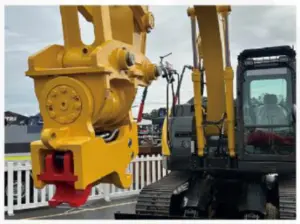
The torque generated by an external load depends on its force and the perpendicular distance between that force and the rotation axis. As an attachment rotates, this distance changes, even when the attachment’s weight remains constant.
For example, a rotating arm carrying a heavy load may generate a relatively small gravitational moment when positioned vertically. As the arm approaches a horizontal position, the moment may increase considerably. The actuator therefore experiences different torque requirements throughout the same operating cycle.
These variations become particularly important in mobile equipment operating on slopes or uneven ground. Changes in machine orientation can alter the direction and magnitude of gravitational loading, affecting the behavior of the connected rotary mechanism.
A suitable hydraulic load-control arrangement helps manage these changing conditions, allowing the mechanism to move through different angles with more predictable rotational behavior.
How Counterbalance Valve Settings Influence Movement
The performance of a counterbalance valve depends on its pressure setting, pilot ratio, flow characteristics, and interaction with other hydraulic components. Different configurations can produce noticeably different movement characteristics, even when installed on similar rotary actuators.
An excessively restrictive setting may require additional hydraulic pressure to initiate or maintain rotation. This increases energy losses and can contribute to unnecessary heat generation. Conversely, a valve that opens too readily may provide insufficient resistance against an overrunning load.
The pilot ratio influences how strongly pressure from the opposing hydraulic line assists valve opening. It affects the balance between operating efficiency and load-control stability. In some hydraulic circuits, unsuitable valve characteristics may contribute to oscillation, vibration, or irregular movement.
These differences explain why counterbalance valve performance is closely connected to the complete hydraulic system rather than the valve alone.
Holding Torque and Drive Torque Are Not the Same
Hydraulic rotary actuator specifications may include both drive torque and holding torque. Although these parameters are related, they describe different operating conditions and mechanical functions.
Drive torque represents the actuator’s ability to produce angular movement under specified hydraulic conditions. Holding torque describes its ability to resist externally applied rotation under defined conditions, including the relevant mechanical and hydraulic limitations.
A counterbalance valve can contribute to hydraulic load management, but it does not increase the mechanical strength of the actuator housing, output shaft, bearings, or mounting structure. External forces generated by heavy attachments or contact with obstacles may still place significant stress on these components.
This distinction is particularly important in construction machinery, where an attachment may experience moderate torque during normal rotation but much greater external forces during excavation or material handling.
Why Counterbalance Valve Location Matters
The location of a counterbalance valve influences the hydraulic connection between the load-control device and the actuator. Depending on the circuit arrangement, the valve may be mounted directly on the actuator or connected through an external hydraulic manifold.
Locating a suitable valve close to the actuator can reduce the length of hydraulic lines between the valve and loaded chamber. This can be relevant to certain hose-failure scenarios and may also simplify the arrangement of hydraulic connections within compact equipment.
However, valve location alone does not guarantee complete protection against hydraulic or mechanical failures. The actual protective function depends on the circuit layout, valve characteristics, and failure conditions.
Integrated load-control arrangements are especially attractive in mobile machinery, where installation space is limited and hydraulic components may be exposed to demanding working environments.
Where Are Rotary Actuators With Counterbalance Valves Used?
Rotary actuators equipped with counterbalance valves are particularly relevant to machinery involving offset loads, gravity-assisted movement, or changing external torque.
Excavator Tilt Attachments
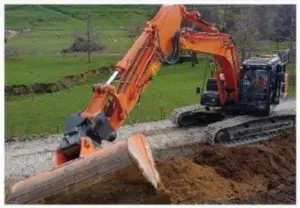
Excavator tilt mechanisms allow buckets and other attachments to rotate into different working positions. Attachment weight and external working forces create changing torque throughout the rotation range. Hydraulic load control can contribute to more consistent movement during grading, positioning, and other precision tasks.
Aerial Work Platforms
Rotary actuators may be used for platform or boom positioning in suitable aerial work platform designs. Changes in structural angle and load distribution can influence rotational behavior. Appropriate hydraulic control is therefore an important part of the complete equipment design, alongside its required safety systems.
Material Handling Equipment
Rotating handling arms, tipping mechanisms, and positioning devices often move loads whose centers of gravity change relative to the rotation axis. Counterbalance valves can help regulate movement in suitable hydraulic arrangements, particularly when gravity assists rotation during unloading or repositioning.
Special-Purpose Vehicles
Municipal machinery, maintenance vehicles, and specialized mobile equipment may use rotary actuators to position working attachments within confined spaces. Compact actuator configurations with hydraulic load-control options can support equipment integration where external forces vary throughout operation.
WEITAI Hydraulic Rotary Actuators With Counterbalance Valve Options
For construction machinery, mobile equipment, and industrial applications, WEITAI provides hydraulic rotary actuator solutions designed to deliver substantial torque and controlled angular movement within compact mechanical arrangements.
WEITAI helical hydraulic rotary actuators combine hydraulic actuation and mechanical torque transmission in an integrated structure. This design supports equipment applications requiring limited-angle rotation without relying on bulky external rotary transmission mechanisms.
Selected hydraulic rotary actuator configurations offer optional counterbalance valves. These options are relevant to mechanisms involving gravity-assisted movement, offset attachments, and changing external loads.
Different torque capacities, rotation angles, mounting arrangements, and hydraulic control options provide flexibility for equipment integration. Specific valve availability and operating characteristics depend on the selected product configuration.
Rotary Actuator With Counterbalance Valve Price and Wholesale Supply
The rotary actuator with counterbalance valve price depends on actuator torque capacity, rotation angle, mounting design, hydraulic displacement, valve configuration, and order quantity. Customized interfaces and specialized hydraulic control requirements may also influence project costs.
As a hydraulic rotary actuator manufacturer and supplier in China, WEITAI supports OEM manufacturing, compatible replacement projects, and wholesale procurement for international machinery manufacturers, distributors, and industrial buyers.
For technical evaluation and quotations, customers can provide the following information:
● Required torque capacity and rotation angle.
● Available hydraulic pressure and flow.
● Mounting dimensions and output connections.
● Equipment application and external load characteristics.
● Required hydraulic control functions and purchase quantity.
Contact WEITAI to explore available hydraulic rotary actuators for sale, discuss counterbalance valve options, and obtain a quotation for your equipment requirements.
Conclusion
A rotary actuator with counterbalance valve provides additional hydraulic control for mechanisms exposed to gravity-assisted movement and changing external loads. By regulating outgoing hydraulic flow, the counterbalance valve helps manage overrunning conditions and contributes to controlled rotation.
WEITAI offers hydraulic rotary actuator solutions with different mechanical configurations and optional load-control features, supporting OEM equipment development, replacement applications, and industrial procurement.
FAQ
Does every hydraulic rotary actuator require a counterbalance valve?
No. The requirement depends on external loading, movement geometry, hydraulic circuit design, and the intended control functions.
Can a counterbalance valve be added to an existing rotary actuator?
Potentially. Compatibility depends on the actuator’s hydraulic interfaces, circuit arrangement, pressure requirements, and available installation space. The existing hydraulic system must support the proposed configuration.
Where can I buy a rotary actuator with counterbalance valve?
WEITAI supplies hydraulic rotary actuators for OEM, replacement, and wholesale applications. Contact WEITAI to confirm available configurations, customization options, and project-specific pricing.
Post time: Nov-25-2026