
Tilt Actuator Uncommanded Motion describes a condition where the operator gives no new tilt command, yet the bucket, tilt coupler or another attachment still changes angle. The movement may appear as a slow drift over several minutes or as a more noticeable position change when the attachment contacts the ground or comes under load.
This condition should not automatically be treated as a failed rotary actuator. A tilt actuator is only one part of a hydraulic circuit, and the main control valve, internal leakage, external load, oil temperature and pressure-control arrangement can all influence whether the attachment holds its position. Effective diagnosis should therefore begin by identifying the conditions under which the movement occurs.
Tilt Actuator Uncommanded Motion Should First Be Divided Into Two Types
When Tilt Actuator Uncommanded Motion appears as slow, continuous drift, the first concern is whether hydraulic oil is gradually moving through an internal leakage path. The actuator may still be capable of generating the required torque, but if oil slowly moves from the loaded side to the lower-pressure side, attachment position can still change.
If movement only occurs when the bucket contacts the ground, digs into material or experiences a significant external load, the diagnosis is different. In this case, the focus should be on the torque created by the external load and whether the hydraulic circuit can maintain pressure on both sides of the actuator under that load.
Separating slow drift from load-induced movement is one of the most important first steps in diagnosing Tilt Actuator Uncommanded Motion.
Stable in the Air Does Not Mean Stable Under Load
Many tilt attachments appear completely normal when tested in the air but begin to change angle during real work. This is not unusual because the external torque acting on the actuator can be very different between unloaded and working conditions.
When the bucket is carrying material, grading or pressing against the ground, the load is transferred through the attachment structure and creates torque around the tilt axis. If the hydraulic circuit provides a path for oil to move, that external torque can force the actuator to rotate even without a new control command.
For this reason, diagnosing uncommanded motion should not rely only on an unloaded test. If the problem appears only under certain loads, it should be evaluated under conditions that are as close as possible to the real operating situation.
Continuous Drift Means the Leakage Path Must Be Identified
When a tilt actuator continues moving with the control in neutral, the real question is where the oil that is supposed to hold the load is going.
The leakage path may be inside the actuator, but it can also be inside the main control valve or another hydraulic component. The fact that the attachment drifts does not by itself identify which component is responsible.
For example, if the actuator holds position much better when its hydraulic ports are properly isolated but begins drifting again when reconnected to the machine control circuit, the diagnosis should not focus only on the actuator.
On the other hand, if the actuator still cannot hold the load when isolated from the main circuit, its internal sealing and load-holding performance should be checked more closely.
Main Control Valve Neutral Behavior Directly Affects Position Holding
When the operator releases the control, the main control valve is not simply “doing nothing.” Its neutral configuration determines whether the two actuator ports are blocked or remain connected to other parts of the hydraulic circuit.
Different machines may use different auxiliary hydraulic circuit designs, so the same tilt actuator can behave differently when installed on different host machines. If the main control valve has significant internal leakage, attachment angle may gradually change even when the actuator itself has no obvious fault.
This is especially important in replacement projects. Installing a new actuator with similar dimensions does not guarantee that the original drift problem will disappear if the actual leakage path remains inside the host machine control circuit.
A Cross-Port Relief Valve Is Not a “Drift Prevention Valve”
A Cross-Port Relief Valve is commonly used in tilt actuator and tilt coupler systems. One of its main functions is to limit excessive pressure when the attachment experiences shock loading or a sudden change in external load.
However, pressure protection and position holding are not exactly the same problem. If the system has an internal leakage path, adjusting the Cross-Port Relief Valve will not necessarily stop continuous drift. Treating every case of Tilt Actuator Uncommanded Motion as a relief-valve setting problem can cause the real fault to be missed.
The better approach is to determine whether the problem comes from overpressure, internal leakage or main-control-valve neutral behavior before changing pressure-control components.
Oil Temperature Can Be an Important Clue
Some machines hold attachment position well when cold but begin drifting more noticeably after the hydraulic system reaches normal operating temperature. This change is useful diagnostic information because hydraulic oil temperature affects viscosity and leakage behavior.
If Tilt Actuator Uncommanded Motion becomes more severe as the oil warms, internal leakage somewhere in the circuit deserves closer attention. However, this does not prove that the actuator itself is responsible because internal leakage inside the control valve can also change with temperature.
For this reason, it is useful to compare machine behavior during cold start and at normal operating temperature instead of relying on a single test immediately after startup.
Brief Movement Should Be Separated From Continuous Drift
Hydraulic hoses can expand slightly as pressure changes, and mechanical structures can deflect under load. As a result, a small attachment movement at the instant load is applied does not always indicate continuous hydraulic drift.
The more important question is whether the attachment continues changing angle after the load becomes stable. If the movement stops quickly, structural or hose elasticity may be involved. If the angle keeps changing, oil may be continuing to move through an internal hydraulic path.
This distinction can reduce unnecessary component replacement and make diagnosis of Tilt Actuator Uncommanded Motion more accurate.
Replacement Tilt Actuators Must Match More Than Size and Rotation Angle
If uncommanded motion starts after an actuator replacement, the hydraulic characteristics of the old and new units should also be compared.
Two tilt actuators may have the same mounting dimensions and rotation range but differ in displacement, flow requirement, pressure characteristics or valve configuration. These differences can change attachment speed and load response.
For this reason, replacement projects should verify host-machine pressure, flow and the original pressure-control arrangement in addition to mounting holes, overall dimensions and rotation angle. Mechanical fit confirms only that the actuator can be installed; it does not guarantee the same hydraulic behavior.
How Does WEITAI Evaluate Tilt Actuator Projects?
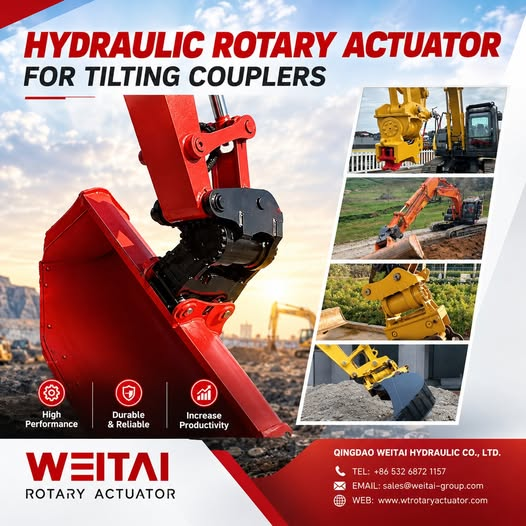
WEITAI provides hydraulic rotary actuators for tilt couplers and other mobile-equipment attachment systems. For OEM projects, actuator configuration can be evaluated according to machine size, attachment load, required rotation range, hydraulic pressure and available flow.
For replacement projects involving drift or Tilt Actuator Uncommanded Motion, it is useful to provide both the original actuator model and the conditions under which the problem occurs. Whether the attachment drifts unloaded, moves suddenly under load or becomes worse after the oil warms can help clarify whether the issue is actuator-related or part of the wider hydraulic system.
For further matching and quotation, useful information includes the machine model or tonnage, original actuator model, mounting dimensions, rotation angle, working pressure, flow and required quantity.
Conclusion
Tilt Actuator Uncommanded Motion does not have one universal cause. External load can force the attachment backward, internal leakage in the actuator or control valve can cause continuous drift, and main-control-valve neutral behavior or oil temperature can also change how well the attachment holds position.
For this reason, the condition in which the movement occurs should be identified before components are replaced. Slow continuous drift, sudden movement under load and brief elastic deflection should be treated as different behaviors rather than one single fault.
For OEM and replacement projects, the tilt actuator should also be evaluated together with the host hydraulic circuit. True compatibility involves more than matching dimensions and rotation angle; pressure, flow and load-control behavior must also suit the real operating condition.
FAQ
What are the most common signs of Tilt Actuator Uncommanded Motion?
Typical signs include slow attachment angle change after the control returns to neutral or unexpected movement when the bucket comes under external load. Different symptoms may point to different parts of the hydraulic system.
Does tilt actuator drift always mean internal leakage inside the actuator?
No. Internal leakage in the actuator, leakage in the main control valve, hydraulic circuit configuration and external load can all produce similar symptoms. The actual operating condition should be checked before identifying the faulty component.
How much does a replacement tilt actuator cost?
Tilt actuator price depends on actuator size, torque requirement, rotation angle, mounting arrangement, hydraulic specifications, valve configuration and order quantity. Providing the original actuator model, machine size and hydraulic conditions makes it easier to confirm a suitable replacement solution and quotation.
Can another brand of tilt actuator be replaced with a WEITAI actuator?
A replacement or alternative can be evaluated, but compatibility should include mounting dimensions, rotation range, working pressure, flow, load conditions and valve configuration rather than external appearance alone.
Post time: Nov-07-2026