
Rotation is an essential movement in many industrial machines. From drilling equipment and construction attachments to marine systems and material handling machinery, equipment often needs to rotate heavy components with accuracy and stability.
As equipment becomes more compact and powerful, manufacturers are looking for rotary solutions that can reduce mechanical complexity while maintaining strong performance. This is where a Hydraulic Rotary Actuator provides a practical alternative.
Unlike traditional rotation systems that require several connected components, a hydraulic rotary actuator integrates hydraulic power conversion and rotary movement into one compact unit. It can deliver high torque output, stable positioning, and reliable load control, making it suitable for heavy-duty applications.
What Problems Exist in Traditional Rotation Systems?
Many heavy machines still rely on hydraulic motors combined with gearboxes or mechanical transmission structures to achieve rotation. However, when equipment operates under high loads or frequent working cycles, these designs may face several limitations.
One common challenge is system complexity. A traditional rotation mechanism usually requires several separate components to work together. More components mean more connection points, more installation requirements, and more potential maintenance issues.
Another challenge is space efficiency. Modern equipment manufacturers often need to create compact machines without sacrificing performance. Large mechanical transmission systems can limit design flexibility, especially in mobile equipment where installation space is restricted.
Traditional systems may also experience mechanical backlash and efficiency losses caused by multiple transmission stages. When precise positioning or stable load holding is required, these factors can affect equipment operation.
A hydraulic rotary actuator helps address these challenges by combining the driving and rotating functions into a single hydraulic component.
Why Is a Hydraulic Rotary Actuator a Better Choice for Compact High-Torque Applications?
The biggest advantage of a hydraulic rotary actuator is its ability to provide high torque output within a compact structure.
For heavy equipment, the challenge is not only creating rotation but also controlling large loads safely and efficiently. A suitable actuator must provide enough torque to start movement, maintain smooth rotation, and hold the load in position when required.
Compared with traditional systems, hydraulic rotary actuators offer several benefits:
- High torque density: More rotational force can be achieved within a smaller installation space.
- Integrated structure: Fewer mechanical components simplify equipment design.
- Stable load control: The actuator can provide reliable positioning under heavy loads.
- Reduced maintenance requirements: A simpler structure helps reduce potential failure points.
These advantages make hydraulic rotary actuators especially suitable for machines where space, strength, and reliability are equally important.
How Does Helical Spline Technology Improve Rotary Actuator Performance?
The internal structure plays an important role in determining the performance of a hydraulic rotary actuator.
A Helical Hydraulic Rotary Actuator uses a helical spline mechanism to convert hydraulic pressure into rotary movement. Compared with conventional rotary mechanisms, this design allows the actuator to achieve high torque output while maintaining a compact size.
The helical spline structure provides smoother force transmission between internal components, helping improve:
- Torque efficiency
- Rotation stability
- Load handling capability
- Long-term durability
For heavy-duty equipment, smooth torque transmission is especially important because machines often operate under changing loads and repeated cycles.
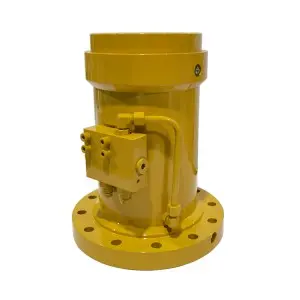
The WL30 Series from WEITAI uses a helical hydraulic rotary actuator design, providing a drive torque of up to 18,000 Nm at 21 MPa and holding torque up to 46,000 Nm, making it suitable for applications requiring strong rotation force and reliable positioning.
Why Does Load Holding Capability Matter in Rotary Equipment?
In many industrial applications, the actuator does not only need to rotate a component. It also needs to keep the component safely positioned after movement.
For example, lifting platforms, drilling equipment, and heavy attachments often need stable positioning during operation. If the rotation system cannot effectively control the load, it may lead to unwanted movement, reduced accuracy, or safety risks.
A heavy-duty hydraulic rotary actuator provides strong holding capability, allowing equipment to maintain its position under external forces.
This feature is valuable in applications such as:
- Crane and lifting equipment positioning
- Working platform rotation
- Equipment attachment adjustment
- Marine system operation
For additional system protection, suitable hydraulic control components can also be integrated according to application requirements.
Where Are Hydraulic Rotary Actuators Commonly Used?
Because of their compact structure and high torque capability, hydraulic rotary actuators are widely used in industries requiring controlled heavy-duty rotation.
Drilling and Construction Equipment
Drilling machines and construction equipment often require precise positioning and powerful rotation control. Hydraulic rotary actuators help equipment achieve stable movement while handling large external loads.
Typical applications include:
- Drilling attachments
- Boom positioning systems
- Construction equipment accessories
Material Handling Systems
Material handling equipment frequently needs repeated rotation and accurate positioning.
Applications include:
- Industrial handling machines
- Lifting equipment
- Heavy-duty attachments
The compact design of hydraulic rotary actuators helps manufacturers reduce system size while maintaining performance.
Marine and Offshore Equipment
Marine equipment operates in demanding environments where reliability is critical.
Hydraulic rotary actuators are used in:
- Marine lifting systems
- Hatch positioning equipment
- Offshore machinery
Their strong load capability and durable design make them suitable for challenging working conditions.
WEITAI WL30 Series Hydraulic Rotary Actuator Solution
For manufacturers developing heavy-duty equipment, selecting the right rotary actuator is an important part of machine design.
WEITAI WL30 Series is designed for applications requiring powerful and reliable rotary movement. With high torque output, flexible mounting options, and a compact helical design, the WL30 Series helps equipment manufacturers develop more efficient rotation systems.
Key features include:
- Drive torque up to 18,000 Nm
- Holding torque up to 46,000 Nm
- 180° and 360° rotation options
- Front and rear flange mounting solutions
- Heavy-duty design for demanding applications
The WL30 Series is suitable for construction machinery, mining equipment, agricultural machines, marine systems, energy equipment, and material handling applications.
Through hydraulic technology and manufacturing experience, WEITAI provides reliable rotary actuator solutions that help global equipment manufacturers improve machine performance and simplify system design.
Conclusion
A Hydraulic Rotary Actuator provides an efficient solution for heavy equipment requiring powerful and stable rotary movement.
Compared with traditional mechanical rotation systems, hydraulic rotary actuators reduce structural complexity while offering advantages in torque output, installation flexibility, and load control.
For industries such as construction, drilling, marine, agriculture, and material handling, selecting a suitable Helical Hydraulic Rotary Actuator can improve equipment efficiency and long-term reliability.
WEITAI WL30 Series provides a reliable rotary solution for demanding applications, helping equipment manufacturers create stronger, more compact, and more efficient machines.
FAQ
1. What is the main advantage of a hydraulic rotary actuator?
A hydraulic rotary actuator provides high torque output in a compact structure and allows equipment to achieve reliable rotary movement with fewer mechanical components.
2. How is a hydraulic rotary actuator different from a hydraulic motor?
A hydraulic motor mainly provides continuous rotation, while a hydraulic rotary actuator is designed for controlled angular movement, positioning, and high-load rotation applications.
3. Why are helical hydraulic rotary actuators suitable for heavy equipment?
The helical spline design enables efficient torque transmission, strong load handling capability, and compact installation.
4. What should be considered when selecting a rotary actuator?
Key factors include torque requirement, rotation angle, pressure rating, mounting method, load conditions, and operating environment.
Post time: Jul-14-2026