
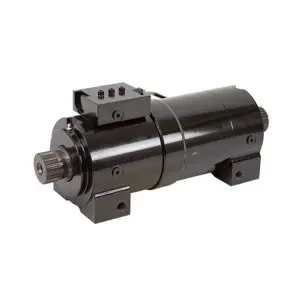
A heavy-duty machine does not always need a larger structure to achieve stronger movement. In many cases, what the equipment really needs is a more compact and efficient way to create controlled rotation. This is where a 6700Nm helical hydraulic rotary actuator becomes valuable. For machinery that needs powerful limited-angle rotation, the WL40 Series Helical Hydraulic Rotary Actuator provides a practical alternative to bulky cylinder-linkage structures.
In construction machinery, marine equipment, lifting machinery, agricultural equipment, industrial handling systems, and special vehicles, rotation is often required for positioning, tilting, folding, swinging, or adjusting a working mechanism. Traditional designs may use a hydraulic cylinder with external arms and pivot points, but this can make the machine larger, more complicated, and harder to maintain. A helical rotary actuator helps integrate rotary movement into a compact hydraulic unit, making the whole structure cleaner and easier to control.
From Linkage Design to Integrated Rotary Motion
Many equipment designers are familiar with using linear cylinders to create rotary movement. A cylinder pushes a lever, the lever rotates around a pin, and the machine completes the required action. This method is common, but it also brings limitations.
A linkage system may create:
- More exposed mechanical parts
- Extra pin and bushing wear
- Larger installation space
- More difficult protection against mud and dust
- Less consistent torque through the movement range
- More complicated assembly and adjustment
A helical hydraulic rotary actuator works differently. It directly converts hydraulic pressure into rotary output through its internal structure. This allows the designer to place rotation closer to the working point and reduce dependence on external mechanical linkage.
For OEM machinery, this can make the equipment more compact and more refined, especially when the machine must work in limited space.
Why 6700Nm Torque Is Useful in Real Equipment
The WL40 Series 6700Nm model is suitable for equipment that requires stronger rotational force. In real working conditions, the load is rarely stable. A platform, arm, attachment, or positioning structure may face uneven resistance, sudden impact, or changing load direction. If the actuator does not provide enough torque, the mechanism may hesitate, drift, or fail to hold position.
A 6700Nm helical hydraulic rotary actuator can support equipment that needs:
- Strong rotation under load
- Stable holding ability
- Smooth movement across a wider working angle
- Less reliance on large mechanical arms
- Better control during repeated operation
- A compact structure without sacrificing power
Torque is not only about moving a part once. It is about maintaining dependable movement under pressure, load, and repeated cycles.
220-Degree Rotation Gives More Working Flexibility
Many hydraulic rotation applications do not need continuous 360-degree movement. Instead, they need a defined rotation range that is wide enough for actual work. A 220-degree rotation range can give designers more flexibility than a simple short-angle actuator.
This type of rotation can be useful for:
- Boom positioning
- Platform or basket rotation
- Davit rotation
- Drill positioning
- Attachment rotation
- Conveyor positioning
- Access ramp deployment
- Mast or hatch positioning
- Pipe handling systems
- Brush or nozzle positioning
The advantage is controlled motion within a useful working angle. The system does not need to rotate endlessly; it needs to rotate accurately, hold position, and return smoothly.
Counterbalance Valve Option for Safer Control
In hydraulic rotation systems, control is as important as power. If a hydraulic line fails or the load creates excessive torque, uncontrolled movement can damage the machine or create safety risks. This is why a counterbalance valve option can be important for some applications.
A counterbalance valve helps protect the rotary actuator against excessive torque loading and helps control rotation in hydraulic failure situations. For equipment that works at height, handles heavy loads, or operates near people, this option can improve system confidence.
Not every application requires the same valve configuration. Engineers should decide based on load type, working angle, safety requirement, and hydraulic circuit design.
Why Interchangeability Matters for OEM and Aftermarket Users
Equipment manufacturers and maintenance teams often need parts that can fit existing machine designs. A rotary actuator that is interchangeable with common market models can reduce redesign work and simplify sourcing.
For OEM manufacturers, interchangeability can help shorten product development time. For replacement users, it can help restore machine function without making unnecessary changes to the equipment structure.
However, interchangeability should always be checked carefully. Torque, rotation angle, shaft connection, mounting type, port position, valve option, and installation dimensions should all be confirmed before replacement.
Applications Where WL40 Series Can Add Value
The WL40 Series Helical Hydraulic Rotary Actuator is suitable for equipment where strong limited-angle rotation is needed. It is especially useful when the machine needs high torque, compact installation, and frequent working cycles.
Possible applications include:
- Construction machinery attachments
- Aerial work platform positioning
- Marine deck equipment
- Industrial handling arms
- Agricultural implement adjustment
- Special vehicles
- Access ramp systems
- Drill and nozzle positioning
- Heavy-duty folding structures
In these machines, the actuator is not just a component. It helps shape the overall structure and movement strategy.
How WEITAI Supports Hydraulic Rotary Actuator Solutions
WEITAI focuses on hydraulic rotary actuator solutions for construction machinery and special vehicles. The value is not only providing a product with torque output, but also helping equipment match real working conditions.
For OEM projects, key considerations often include:
- Rotation angle
- Torque output
- Mounting space
- Hydraulic pressure
- Holding torque
- Load direction
- Cycle frequency
- Port design
- Counterbalance valve requirement
- Replacement compatibility
By matching these factors properly, the rotary actuator can help the machine become more stable, compact, and easier to operate.
Conclusion
A 6700Nm helical hydraulic rotary actuator is a practical solution for heavy-duty equipment that needs strong limited-angle rotation without a complicated linkage system. The WL40 Series supports compact design, high torque output, controlled 220-degree rotation, and optional protection through a counterbalance valve.
For machinery designers and replacement buyers, the main value of this actuator is not only power. It helps simplify structure, reduce exposed mechanical parts, improve movement control, and support more integrated hydraulic equipment design.
FAQ
What is a 6700Nm helical hydraulic rotary actuator used for?
It is used for machinery that needs strong limited-angle rotation, such as positioning, tilting, folding, attachment rotation, platform rotation, or heavy-duty structure movement.
Why choose a rotary actuator instead of a cylinder linkage?
A rotary actuator can reduce external linkage parts, save installation space, provide direct torque output, and simplify machine structure.
What is the benefit of 220-degree rotation?
A 220-degree rotation range gives equipment a wider working angle for positioning, swinging, folding, or rotating functions without requiring continuous rotation.
Why is a counterbalance valve useful?
A counterbalance valve can help control load movement and protect the actuator from excessive torque or hydraulic line failure situations.
Post time: Jul-03-2026