
In modern marine engineering, equipment reliability and motion control precision are critical factors that directly influence operational safety, efficiency, and long-term vessel performance. A 360 degrees hydraulic rotary actuator is specifically designed to provide continuous rotational motion in demanding offshore and onboard marine environments where equipment must operate under constant vibration, saltwater exposure, heavy loads, and unpredictable working conditions.
Unlike limited-angle rotary devices, a 360-degree hydraulic rotary actuator enables full continuous rotation without mechanical restriction, making it an ideal solution for marine systems that require uninterrupted movement, flexible positioning, and high torque output in compact installation spaces. This capability is particularly valuable in shipboard machinery where space is limited but performance demands are extremely high.
Continuous Rotation Capability for Marine Working Systems
Marine equipment often requires unrestricted rotational movement to perform tasks such as lifting, anchoring, steering assistance, cargo handling, and deck operations. A 360-degree hydraulic rotary actuator provides smooth and continuous motion, ensuring that mechanical systems can operate without angular limitations.
● Continuous rotation allows winches and lifting systems to operate without reset cycles, improving operational efficiency during long-duration marine tasks.
● Full rotation capability supports crane systems that require flexible positioning when handling cargo in changing sea conditions.
● The hydraulic drive ensures consistent torque output even when external forces fluctuate due to wave motion and vessel instability.
● Unrestricted movement reduces mechanical stress caused by stopping and reversing rotation, improving system longevity in marine environments.
Why Marine Environments Require Heavy-Duty Hydraulic Rotary Systems
Marine environments are among the most challenging working conditions for mechanical equipment due to constant exposure to saltwater corrosion, high humidity, vibration, and mechanical shock loads caused by wave impact and vessel movement. Hydraulic rotary actuators used in such environments must be engineered for extreme durability and long-term reliability.
● Saltwater exposure accelerates corrosion, requiring sealed hydraulic systems with high resistance to environmental degradation.
● Continuous vibration from engines and wave motion demands strong internal structural integrity to maintain performance stability.
● Heavy lifting and cargo handling operations require high torque output to ensure safe and controlled movement under load.
● Long operating cycles at sea require systems with minimal maintenance needs and extended service life to reduce downtime.
High Torque Output for Demanding Marine Equipment
Marine applications often involve heavy lifting, pulling, and positioning tasks that require significant torque output. A 360 degrees hydraulic rotary actuator is designed to deliver stable and consistent torque across the entire rotation cycle, making it suitable for heavy-duty marine machinery.
● Winch systems benefit from stable torque output that ensures controlled cable tension during anchoring and lifting operations.
● Deck cranes require precise rotational control when handling heavy cargo in unstable sea conditions.
● Steering and auxiliary positioning systems rely on consistent hydraulic force to maintain directional stability.
● Offshore equipment demands high torque density in compact systems where installation space is limited.
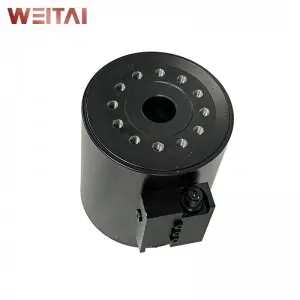
Compact Design for Limited Shipboard Space
Space optimization is a critical requirement in marine engineering, where every mechanical component must be carefully integrated into confined ship structures. A 360-degree hydraulic rotary actuator provides high performance within a compact footprint, making it suitable for modern vessel design.
● Compact hydraulic integration reduces the need for bulky mechanical transmission systems on deck or within hull compartments.
● Space-saving design allows easier installation in confined machinery rooms and deck-mounted systems.
● High torque density enables smaller actuator size without sacrificing performance capability.
● Simplified structural layout improves overall system efficiency and reduces installation complexity.
Resistance to Corrosion and Harsh Marine Conditions
One of the most important requirements for marine hydraulic systems is resistance to corrosion and environmental degradation. A properly designed 360-degree rotary actuator uses sealed structures and durable materials to ensure long-term operation in saltwater environments.
● Sealed housing design prevents seawater and moisture from entering internal hydraulic components.
● Corrosion-resistant materials improve durability under continuous salt spray exposure.
● Reinforced structural components reduce wear caused by vibration and mechanical shock.
● High-performance sealing systems maintain hydraulic pressure stability during long-term operation.
Applications of 360 Degrees Hydraulic Rotary Actuators in Marine Systems
The versatility of continuous rotation hydraulic actuators makes them suitable for a wide range of marine equipment and vessel systems where precise motion control is required.
● Marine winch systems used for anchoring, towing, and lifting operations under heavy load conditions.
● Deck cranes for cargo handling, container movement, and offshore logistics operations.
● Steering assistance systems in specialized vessels requiring precise directional control.
● Offshore platform equipment used in drilling support and maintenance operations.
● Shipboard automation systems requiring rotational positioning for mechanical arms and tools.
● Fishing and aquaculture equipment used for net handling and rotational deployment systems.
Operational Stability Under Dynamic Marine Conditions
Marine environments are highly dynamic, with constant motion caused by waves, wind, and vessel movement. Hydraulic rotary actuators used in these environments must maintain stable performance even when external forces are continuously changing.
● Hydraulic pressure balance ensures smooth rotation even under sudden load variations.
● Internal damping effects reduce mechanical shock during directional changes.
● Stable motion control improves operator safety during cargo handling operations.
● Consistent performance reduces risk of mechanical failure during critical marine operations.
Why Hydraulic Rotary Technology Is Preferred in Marine Engineering
Hydraulic rotary systems are widely used in marine applications because they offer a combination of strength, flexibility, and reliability that mechanical systems cannot easily achieve in harsh environments.
● They provide high torque output in compact structures suitable for shipboard integration.
● They deliver smooth and controllable motion under variable load conditions.
● They reduce mechanical wear by eliminating complex gear-based transmission systems.
● They are adaptable to a wide range of marine applications from small vessels to offshore platforms.
FAQ
1. What is a 360 degrees hydraulic rotary actuator used for in marine applications?
It is used to provide continuous rotational motion for marine equipment such as winches, cranes, steering systems, and offshore machinery requiring full rotation capability.
2. Why is continuous rotation important in marine equipment?
Continuous rotation eliminates movement restrictions, allowing equipment to operate smoothly during long-duration tasks such as lifting, anchoring, and cargo handling without interruption.
3. Can hydraulic rotary actuators withstand saltwater environments?
Yes, marine-grade rotary actuators are designed with sealed structures and corrosion-resistant materials to withstand saltwater exposure and harsh offshore conditions.
4. What are the main advantages of hydraulic rotary systems in marine use?
They provide high torque in compact designs, stable motion control under load variation, reduced mechanical wear, and long service life in demanding marine environments.
Post time: Jun-08-2026