
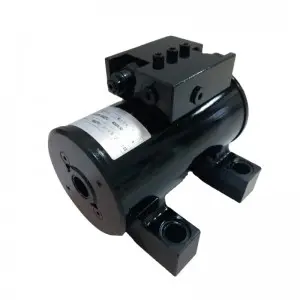
The WEITAI WL20 Series hydraulic rotary actuator is designed as a practical and cost-effective solution for a wide range of industrial applications that require controlled 180-degree rotation with stable torque output and compact installation structure. With five standard sizes available and torque output ranging from 500 Nm up to 4200 Nm at 21 MPa, the WL20 Series is engineered to deliver reliable rotary performance in equipment where precision movement, safety, and efficiency are essential.
Unlike complex mechanical rotation systems that rely on multiple components, the WL20 Series integrates hydraulic power and rotary motion into a single compact unit, making it easier to install, operate, and maintain while reducing overall system cost and mechanical complexity. This makes it especially suitable for equipment manufacturers and end users seeking dependable motion control without excessive engineering burden.
Why Is the WL20 Series Considered a Cost-Effective Hydraulic Rotary Solution?
In modern industrial equipment design, cost efficiency is not only about initial purchase price but also about installation simplicity, maintenance requirements, system reliability, and long-term operational performance. The WL20 Series is designed with all of these factors in mind, offering a balanced solution that supports both performance and affordability.
● The integrated hydraulic rotary structure eliminates the need for external gears, linkages, or complex mechanical transmission systems, which reduces both design complexity and assembly costs.
● The availability of five standard sizes allows users to select a model that matches torque requirements precisely, avoiding unnecessary oversizing and improving system efficiency.
● The compact footprint of the actuator helps reduce installation space requirements, which is particularly important in aerial work platforms and compact lifting equipment.
● The simplified maintenance structure reduces long-term service costs and improves equipment uptime in continuous industrial operations.
180-Degree Rotation Design for Controlled Industrial Motion
The WL20 Series is specifically engineered for 180-degree rotational output, making it ideal for applications where controlled swinging, tilting, or directional adjustment is required. This limited-angle rotation design ensures stable motion control while maintaining high safety and precision standards in dynamic working environments.
● 180-degree rotation is widely used in aerial work platforms where basket or arm positioning must be precise and stable during elevated operations.
● The controlled rotation range helps prevent over-rotation risks, improving operational safety in lifting and working-at-height equipment.
● The smooth hydraulic motion ensures consistent speed and torque delivery throughout the full rotation range, improving operator control and machine responsiveness.
● The design is optimized for repetitive motion cycles, making it suitable for industrial environments that require frequent directional adjustments.
Foot Mounting Design for Simple Installation and Structural Stability
One of the key structural advantages of the WL20 Series is its foot mounting configuration, which provides strong installation stability while simplifying mechanical integration into different types of equipment platforms.
● Foot mounting allows direct attachment to machine frames, reducing the need for additional support structures or complex bracket systems.
● The mounting design improves load distribution, helping maintain structural balance during high-torque rotation operations.
● Installation flexibility makes it easier for manufacturers to integrate the actuator into existing machine designs without major structural modifications.
● The stable mounting system enhances operational safety, especially in applications involving lifting, swinging, or extended arm movement.
Where Is the WL20 Series Hydraulic Rotary Actuator Commonly Used?
The WL20 Series is widely used in industrial and mobile equipment where controlled rotation is required to improve operational flexibility, safety, and efficiency. Its compact design and reliable torque output make it suitable for multiple application scenarios across different industries.
● In aerial work platforms, it is used to rotate baskets or working arms, ensuring stable positioning during elevated operations.
● In crane systems, it supports controlled rotation functions that improve load handling accuracy and operational safety.
● In spider lifts, it provides compact and precise rotational control in machines designed for confined or uneven working environments.
● In material handling equipment, it is used for directional movement, tilting, and positioning of mechanical arms or attachments.
● In general industrial machinery, it is applied wherever controlled angular motion is required in compact installation spaces.
Performance Advantages in Real-World Applications
The WL20 Series is designed to perform reliably under real operational conditions where equipment is exposed to varying loads, repeated motion cycles, and environmental challenges. Its hydraulic structure ensures stable performance even in demanding industrial environments.
● Stable torque output from 500 Nm to 4200 Nm allows the actuator to be used across a wide range of machine sizes and load conditions.
● Smooth hydraulic control ensures consistent motion without sudden jumps or mechanical backlash, improving operational precision.
● The compact design reduces overall machine weight and simplifies system architecture, improving mobility and energy efficiency.
● Durable construction supports long-term operation with reduced wear, making it suitable for high-frequency industrial use.
How Does the WL20 Series Improve Equipment Design Efficiency?
Modern equipment design increasingly focuses on compact systems, simplified structures, and multifunctional components. The WL20 Series supports these trends by integrating rotary motion into a single hydraulic unit that reduces the need for additional mechanical systems.
● It simplifies machine design by replacing multi-component rotation assemblies with a single integrated actuator.
● It reduces engineering complexity, allowing faster product development and easier system integration.
● It improves design flexibility by offering multiple torque ranges within a standardized product family.
● It supports lightweight equipment development by reducing unnecessary mechanical structures.
Why Hydraulic Rotary Actuators Are Becoming More Popular in Industrial Equipment
Hydraulic rotary actuators like the WL20 Series are increasingly used in modern industrial systems because they provide a combination of strength, compactness, and control precision that traditional mechanical systems often cannot achieve.
● They deliver high torque output in a compact structure, making them ideal for space-limited equipment.
● They provide smooth and continuous motion control, which is essential for safe and precise operations.
● They reduce mechanical wear by eliminating complex transmission systems, improving long-term reliability.
● They are adaptable to a wide range of industrial applications, from lifting systems to material handling machinery.
FAQ
1. What is the main purpose of the WL20 Series hydraulic rotary actuator?
The WL20 Series is designed to provide controlled 180-degree rotary motion with stable torque output for industrial equipment such as aerial platforms, cranes, and material handling systems.
2. What torque range does the WL20 Series support?
The WL20 Series offers torque output from 500 Nm up to 4200 Nm at 21 MPa, covering a wide range of light to medium-duty applications.
3. What types of equipment commonly use the WL20 Series?
It is widely used in aerial work platforms, cranes, spider lifts, and material handling equipment that require controlled rotational movement.
4. What is the advantage of the foot mounting design?
The foot mounting design provides stable installation, simplifies integration into machine frames, and improves structural balance during operation.
Post time: Jun-05-2026