
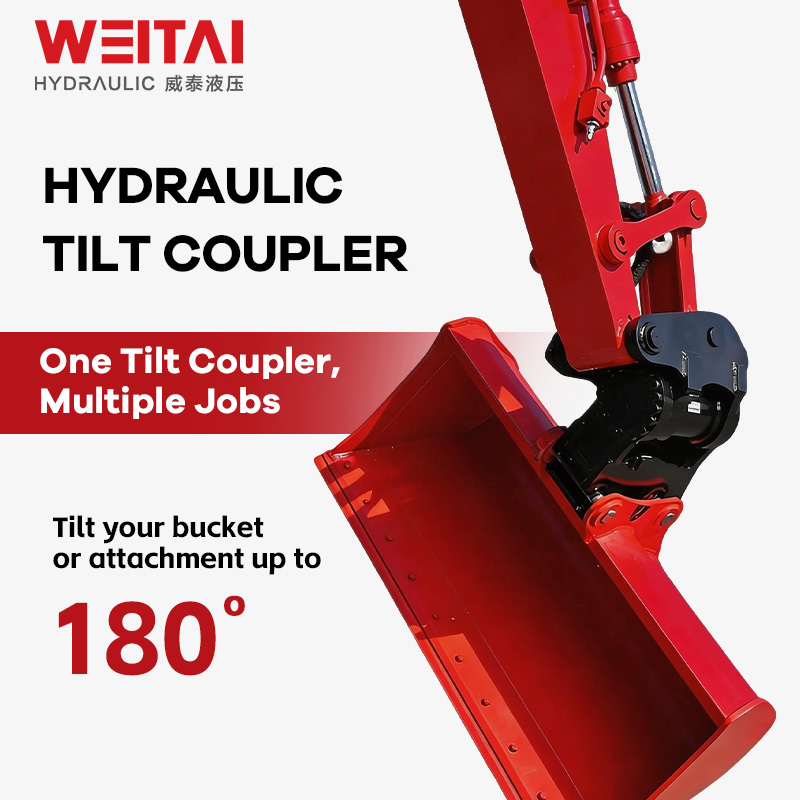
A Hydraulic Power Tilt is a hydraulic tilting system installed between an excavator stick and a bucket or other attachment. It allows the attachment to tilt in a controlled side-to-side direction. Unlike a traditional fixed connection, Power Tilt enables the operator to adjust the attachment angle hydraulically from inside the cab without repeatedly repositioning the entire excavator.
This additional movement is particularly useful for grading, ditch cleaning, slope shaping, landscaping, trench finishing, backfilling, and working close to walls. In these applications, the excavator often does not need more digging force. Instead, the attachment needs to contact the working surface at a more suitable angle.
The most direct value of Hydraulic Power Tilt can therefore be summarized simply: change the attachment angle instead of repeatedly moving the entire excavator.
Why Fixed Attachments Lead to Repeated Machine Repositioning
With a conventional fixed bucket, the working angle is mainly determined by the boom, stick, and position of the excavator itself. When the working surface has a slope or side angle, the operator usually needs to move the machine, adjust the boom position, or approach the area again from another direction.
This limitation becomes especially noticeable during:
- Continuous slope finishing
- Cleaning both sides of drainage ditches
- Finishing trench bottoms and sidewalls
- Grading around foundations
- Working close to walls or curbs
- Landscaping on irregular ground
- Backfilling around structures and pipelines
The actual digging movement may take only a few seconds, but repositioning the machine after each section repeatedly interrupts the working rhythm.
Hydraulic Power Tilt changes this process by allowing the bucket angle to be adjusted independently of the excavator body. The machine can remain in a useful position while the attachment follows slopes and changing ground profiles more directly.
The purpose of Power Tilt is therefore not simply to add another movement, but to reduce unnecessary repositioning of the whole machine.
How Does a Hydraulic Power Tilt Work?
Power Tilt uses hydraulic pressure to generate controlled angular movement at the attachment connection.
In an integrated rotary design, hydraulic oil enters a rotary actuator installed between the excavator stick and the coupler or attachment. Internal hydraulic force is converted into rotary torque, causing the lower attachment interface to tilt left or right.
The operator controls the movement directly from the cab. When hydraulic flow is directed to one side of the actuator, the attachment tilts in one direction. Reversing the hydraulic flow moves it in the opposite direction.
A conventional hydraulic cylinder mainly produces linear motion and then relies on an external linkage to convert that movement into rotation. An integrated hydraulic rotary actuator, by contrast, creates angular movement directly inside the tilt mechanism.
This design can reduce external linkages and moving components while keeping the overall tilt assembly more compact.
Tilting Is Only the First Step—Holding the Angle Under Load Matters More
When evaluating a Power Tilt, it is easy to focus only on the maximum tilt angle. However, the ability to maintain the attachment position after it reaches the required angle is equally important.
When a grading bucket contacts the ground at an angle, external loads are transferred back through the attachment into the Power Tilt. The system may therefore experience more than rotary torque, including:
- Bending loads
- Side loads
- Sudden impact loads
- Attachment weight
- Position-holding loads
- Repeated hydraulic pressure cycles
If the attachment angle changes continuously under working load, the operator must keep correcting its position, reducing the practical value of the hydraulic tilt system.
A useful Power Tilt therefore needs sufficient driving torque to move the attachment and enough holding capacity to maintain the required working angle.
Stable position holding is especially important for slope finishing, trench shaping, grading, and other applications where the cutting edge must remain at a consistent angle.
Why Hydraulic Routing Matters More on a Tilting Attachment
Adding hydraulic tilt creates a practical challenge: hydraulic hoses still need to supply oil while the attachment continually changes angle.
If external hoses form large moving loops around the tilt mechanism and repeatedly bend, rub, or twist, they may be exposed to:
- Abrasion
- Pinching
- Excessive bending
- Impact from soil and stones
- Roots and construction debris
- Interference with the attachment itself
An integrated hydraulic rotary union provides another solution. Hydraulic oil can pass through the tilt structure internally, reducing large movements of exposed hoses around the rotating section.
This becomes even more important when the excavator also uses a hydraulic quick coupler or another hydraulic attachment, because several hydraulic functions may need to pass through the same area.
Cleaner hydraulic routing can reduce hose interference while also helping keep the complete attachment installation compact.
What Happens When a Tilted Attachment Hits an Obstacle?
Loads in real excavation work are rarely completely predictable.
A bucket operating at an angle may suddenly strike rock, hard soil, buried material, or another obstacle. Because the attachment is already tilted, the impact can create an immediate pressure spike inside the hydraulic tilt circuit.
This is where hydraulic protection becomes important.
A Cross-Port Relief Valve can release excessive pressure when an external impact causes system pressure to rise beyond the normal operating range. Its purpose is not to increase normal digging performance, but to help protect the hydraulic tilt mechanism from unexpected impact loads on the job site.
Because the Power Tilt is installed close to the attachment, repeated impacts and load reversals are a normal part of its working environment. Overload protection therefore has practical value in real excavation conditions.
Main Benefits of Hydraulic Power Tilt in Real Excavation Work
The value of Power Tilt is easiest to understand by looking at how it changes the working process.
Less Machine Repositioning
The operator can adjust the attachment angle directly from the cab instead of repeatedly moving the undercarriage to approach a sloped surface.
During trenching, grading, and slope finishing, this can allow longer continuous working passes with fewer interruptions.
Easier Work on Angled Surfaces
The bucket can follow surfaces that are not parallel with the tracks, making it easier to work on ditch walls, slopes, embankments, and irregular ground.
More Work From the Same Machine Position
Near roads, buildings, walls, underground utilities, or landscaped areas, there may not be enough room to reposition the excavator freely.
Changing the attachment angle provides additional digging and cutting directions without significantly moving the complete machine.
More Continuous Fine Finishing
During final grading and trench shaping, maximum digging force is often less important than maintaining a consistent surface and working angle.
Power Tilt helps keep the bucket at a more suitable angle and reduces repeated corrections, making finishing work more continuous.
Greater Attachment Flexibility
Hydraulic Power Tilt can work with buckets and other compatible excavator attachments, allowing the same carrier to perform more multi-angle tasks without changing the basic machine structure.
This is one reason Power Tilt is widely used for grading, ditch cleaning, landscaping, slope shaping, and trench finishing.
Where Does Hydraulic Power Tilt Provide the Most Value?
Power Tilt provides the greatest benefit when the operator frequently needs to change the working angle of the attachment.
Typical applications include:
- Ditch cleaning: Reduce machine movement and reach both sides of the ditch more easily.
- Slope shaping: Allow the bucket to follow an inclined surface while the excavator remains in a stable position.
- Grading: Maintain a controlled bucket angle for more continuous finishing passes.
- Landscaping: Adapt more easily to irregular ground and detailed surface work.
- Trench finishing: Improve access to trench bottoms and sidewalls.
- Working near walls: Adjust the attachment angle where undercarriage movement is restricted.
- Backfilling: Direct material more accurately around structures or pipelines.
If the machine mainly performs straight excavation and the bucket remains in a fixed orientation most of the time, the benefit of Power Tilt may be relatively limited.
It provides the greatest value in applications where achieving the correct working angle would otherwise require frequent excavator repositioning.
WEITAI Hydraulic Power Tilt Solutions
WEITAI develops Hydraulic Power Tilt products for excavator applications using integrated hydraulic rotary actuation.
The current Power Tilt range includes WP, WT, WBV, and WPT configurations for different excavator sizes and attachment requirements. Depending on the series, tilt ranges such as 140° and 180° are available.
For different excavator and attachment applications, the Power Tilt system can be configured around machine size, mounting arrangement, coupler interface, hydraulic requirements, and required movement range.
The objective is not simply to add hydraulic rotation between the excavator and the bucket. It is to provide useful multi-angle attachment movement while maintaining stable positioning, practical hydraulic routing, and usable working geometry.
FAQ
What Is Hydraulic Power Tilt Mainly Used For?
Hydraulic Power Tilt adds controlled side-to-side tilting to excavator attachments. It is commonly used for grading, ditch cleaning, slope shaping, trench finishing, landscaping, and other applications where the bucket needs to change angle frequently.
What Is the Difference Between Power Tilt and a Standard Excavator Coupler?
A standard coupler is mainly used to connect and change attachments. Power Tilt adds hydraulic angle adjustment, allowing the operator to change the attachment angle directly from the cab.
Can Hydraulic Power Tilt Reduce Excavator Repositioning?
Yes. By allowing the bucket or attachment angle to move independently from the excavator body, Power Tilt can reduce the need to reposition the undercarriage when working on slopes, ditch walls, edges, and irregular ground.
Why Is an Integrated Rotary Union Useful in a Power Tilt?
It allows hydraulic oil to pass through the tilting structure while reducing large movements of external hoses around the rotating connection. This helps create cleaner hydraulic routing and lowers the risk of hose interference during attachment movement.
Post time: Sep-01-2026