
Choosing the right attachment system can have a direct impact on excavator productivity, especially for machines used in grading, landscaping, trenching, utility installation, and precision construction. When operators want to improve attachment flexibility, two solutions are often compared: Hydraulic Tilt Coupler and Tilt Rotator.
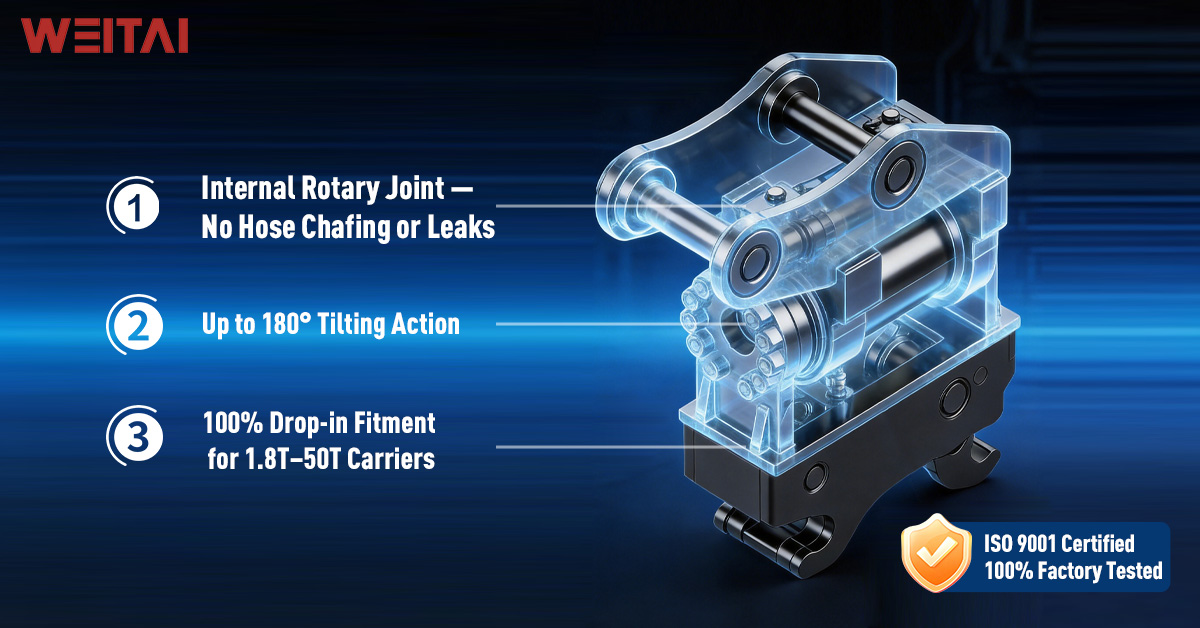
Although both systems allow excavators to perform more flexible operations, they are designed for different working requirements. A Hydraulic Tilt Coupler mainly provides side-to-side tilting movement, allowing the bucket or attachment to follow different working angles without frequently repositioning the machine. A Tilt Rotator, on the other hand, combines tilting and rotation functions, giving the attachment greater freedom of movement and allowing operators to position tools from multiple directions.
Therefore, the better choice is not simply the system with more functions. The right solution depends on the type of work, the required attachment control, and whether the excavator mainly needs angle adjustment or more complete positioning capability.
Why Excavators Need More Flexible Attachment Control
Traditional excavator attachments rely mainly on boom and arm movement to control digging direction. This works well for standard excavation, but many modern applications require more precise control of the attachment angle.
For example, when finishing slopes, cleaning drainage channels, or working around existing structures, the bucket often needs to match different surface angles. Without additional attachment movement, operators may need to repeatedly reposition the excavator to achieve the correct working position.
This not only increases unnecessary machine movement but can also reduce efficiency in projects where accuracy and smooth finishing are important.
Both Hydraulic Tilt Coupler and Tilt Rotator are designed to improve this situation by adding extra movement between the excavator and attachment. However, the amount of flexibility they provide is different, which makes them suitable for different applications.
What Is a Hydraulic Tilt Coupler?
A Hydraulic Tilt Coupler is an excavator attachment connection system that allows the bucket or tool to tilt from side to side through hydraulic control. Compared with a standard quick coupler, which mainly focuses on attachment replacement, a Tilt Coupler adds an additional movement function that improves working angle adjustment.
The biggest advantage of a Hydraulic Tilt Coupler is that operators can change the attachment angle directly from the cab. Instead of moving the entire excavator to match the working surface, the operator can adjust the bucket position according to the actual terrain. Heavy-duty engineered solutions like the hydraulic quick hitch tilt coupler allow operators to rapidly swap attachments while maintaining precise tilting capabilities up to 180 degrees.
This makes Tilt Coupler systems particularly useful for applications such as:
- ✓ Slope finishing and bank leveling
- ✓ Ditch and drain cleaning
- ✓ Trench shaping and pipe bedding
- ✓ Landscaping preparation and fine grading
For many excavators, a Tilt Coupler provides a practical balance between flexibility and simplicity. It improves attachment control while keeping the structure relatively compact and easier to integrate with existing equipment.
What Is a Tilt Rotator?
A Tilt Rotator provides a higher level of attachment flexibility by combining two different movements: tilting and continuous 360-degree rotation.
While a Tilt Coupler allows the attachment to change its side angle, a Tilt Rotator allows the bucket or tool to rotate around its own axis. This additional movement gives operators more control when positioning attachments in complex working environments.
A Tilt Rotator is commonly used in applications where precision and accessibility are especially important, including urban construction, utility installation, pipe laying, landscaping projects, and detailed excavation work.
For example, when working in a narrow construction area, the excavator may not have enough space to reposition frequently. With a Tilt Rotator, operators can adjust the attachment direction directly, reducing unnecessary machine movement and improving working efficiency.
Tilt Coupler vs. Tilt Rotator: Key Differences Compared
The main difference between a Tilt Coupler and Tilt Rotator is the level of attachment control they provide.
Hydraulic Tilt Coupler: Focuses on improving the working angle of the attachment. It is especially useful when the operator needs the bucket to follow slopes, uneven surfaces, or angled structures more effectively.
Tilt Rotator: Provides a wider range of movement because it combines tilting and rotation. This allows the attachment to approach materials from different directions and provides more options for precise positioning.
However, additional functions also mean a more complex structure. Compared with a Tilt Coupler, a Tilt Rotator usually requires more consideration regarding attachment weight, hydraulic system requirements, installation space, and maintenance.
For this reason, a Tilt Rotator is not automatically the best choice for every excavator. The right decision depends on whether the additional rotation capability can create real value in daily operation.
Decision Guide: When to Choose Which System?
When Should You Choose a Hydraulic Tilt Coupler?
A Hydraulic Tilt Coupler is usually the better option when the main requirement is improving bucket angle adjustment rather than adding full rotational movement.
For grading work, the bucket needs to maintain contact with uneven surfaces. During ditch cleaning, the attachment may need to follow different side angles. In these situations, tilt functionality can reduce machine repositioning and make operation more efficient.
A Tilt Coupler is a suitable choice when:
- The excavator mainly performs earthmoving and grading work;
- The attachment angle frequently needs adjustment;
- The operator wants improved bucket control;
- A lighter attachment solution is preferred;
- Full attachment rotation is not necessary.
For general construction, landscaping, and earthwork applications, a Hydraulic Tilt Coupler often provides enough flexibility without adding unnecessary complexity.
When Should You Choose a Tilt Rotator?
A Tilt Rotator becomes more valuable when the excavator performs detailed work that requires frequent attachment positioning changes.
In urban construction, utility projects, and precision landscaping, working space is often limited. Instead of repeatedly moving the excavator, operators can use the rotation function to position the attachment more accurately.
A Tilt Rotator is more suitable for applications where:
- Precise attachment positioning is required;
- The machine frequently works in restricted areas;
- Multiple working directions are needed;
- Fine finishing tasks are common.
The additional rotation capability can improve productivity in complex environments, especially when the operator needs more control over the attachment rather than simply changing its angle.
Technical Considerations: Weight and Hydraulic Requirements
Attachment weight is an important factor when selecting between a Tilt Coupler and Tilt Rotator.
Because a Tilt Rotator contains additional rotating components, it is generally heavier than a Tilt Coupler. Additional weight at the end of the excavator arm can affect lifting capacity, fuel efficiency, and machine balance.
Hydraulic requirements are also different. A Hydraulic Tilt Coupler mainly controls the tilting function, while a Tilt Rotator requires hydraulic power for both tilt and rotation movements. Therefore, the excavator hydraulic system needs to provide suitable flow, pressure, and control capability.
A properly matched hydraulic system helps ensure smoother operation, better attachment response, and longer service life.
WEITAI Hydraulic Tilt Solutions
WEITAI provides hydraulic attachment solutions including Hydraulic Tilt Coupler and related Tilt Rotator products for excavator applications.
The solutions are designed to improve attachment flexibility while supporting different excavator sizes, attachment requirements, and working conditions.
WEITAI hydraulic tilt solutions can be configured according to:
- Excavator size and tonnage;
- Attachment connection requirements;
- Hydraulic system conditions and auxiliary lines;
- Installation structure;
- Required tilt range.
For applications where operators mainly need better bucket angle control, a Hydraulic Tilt Coupler provides an efficient solution. For projects requiring more precise attachment positioning and greater movement flexibility, a Tilt Rotator can provide additional operating capability.
The purpose is not to add unnecessary functions, but to provide the right attachment solution based on actual working requirements.
Frequently Asked Questions (FAQ)
What is the primary difference between a Tilt Coupler and a Tilt Rotator?
A Tilt Coupler mainly provides side-to-side attachment tilting, while a Tilt Rotator combines tilting and continuous 360-degree rotation functions to provide greater attachment movement flexibility.
Is a Tilt Rotator always better than a Hydraulic Tilt Coupler?
No. A Tilt Rotator provides more movement capability, but it also increases system complexity, weight, and hydraulic requirements. A Tilt Coupler may be more suitable when only angle adjustment is needed.
What excavator work benefits most from a Hydraulic Tilt Coupler?
Hydraulic Tilt Couplers are commonly used for grading, slope finishing, ditch cleaning, landscaping, and other applications where the bucket needs to follow different working angles.
Why choose a Tilt Rotator for precision excavation?
A Tilt Rotator allows the attachment to rotate and tilt simultaneously, making it easier to position tools accurately in restricted spaces and complex working environments without moving the main machine.
Post time: Sep-06-2026