
A conventional excavator bucket can dig, load, and backfill efficiently, but its working angle is largely determined by the boom, arm, and machine position. When the bucket edge cannot reach the required angle, the operator often has to reposition the entire excavator.
A PowerTilt Rotary Actuator changes this working method by adding controlled side-to-side tilt between the excavator arm and attachment. Instead of repeatedly moving the undercarriage to adjust the bucket angle, the operator can tilt the attachment directly from the cab.
This additional movement is particularly useful in trench finishing, slope shaping, landscaping, ditch cleaning, and work near walls or underground services. The value does not come from adding another movement simply for flexibility. It comes from allowing the attachment to follow the required surface while the excavator remains in a more stable working position.
The Time Loss Often Happens Between Digging Passes
During excavation, the bucket may remove material quickly, but finishing work usually requires more machine movement.
Consider a trench that needs a level bottom and clean sidewalls. After the main excavation is complete, the operator may need to:
- Reposition the excavator to reach the opposite side
- Adjust the boom repeatedly to correct the bucket angle
- Make several short finishing passes
- Move away from the trench and approach again
- Work carefully around pipes, cables, or nearby structures
These movements do not remove much additional material, but they take time and increase track movement around the site.
With a tilting attachment, the bucket angle can be changed without moving the complete excavator each time. The operator can keep the machine in one position while adjusting the cutting edge to match the trench bottom, sidewall, or surrounding ground.
One Excavator Position, Several Working Angles
The main difference created by a PowerTilt mechanism is the separation between machine position and attachment angle.
A standard bucket normally follows the direction of the excavator arm. A tilting bucket can work at an angle to that direction, allowing the cutting edge to contact surfaces that are not parallel to the machine.
This becomes useful in three common types of work.
Trench Bottom and Sidewall Finishing
After the trench reaches the required depth, the bucket can be tilted to clean one sidewall and then adjusted toward the opposite side.
The excavator does not need to sit perfectly parallel to every section of the trench. This is helpful where site boundaries, traffic lanes, buildings, or stored materials limit machine positioning.
The bucket can also be tilted slightly to create drainage fall along the trench bottom rather than leaving a completely flat surface.
Slope and Embankment Shaping
A slope rarely matches the natural movement path of a standard excavator bucket.
Without attachment tilt, the operator may need to position the excavator at several points along the slope and repeatedly change the boom and arm angle. This can leave visible steps between passes.
A tilting attachment allows the bucket edge to follow the slope more naturally. It can support smoother finishing on:
- Roadside embankments
- Drainage channels
- Landscaping slopes
- Retaining-wall backfill
- Pond edges
- Construction-site access routes
Work Around Obstacles
Excavation near walls, foundations, pipes, posts, and underground services often provides little room for the complete machine to turn.
Attachment tilt allows the bucket to approach the work from a safer machine position while adjusting the cutting edge around the obstacle. The operator can make smaller corrections at the attachment instead of relying only on machine travel and upper-structure rotation.
Conventional Bucket Movement vs. PowerTilt Workflow
The difference is easiest to understand by comparing the working process.
|
Working Stage |
Conventional Fixed Bucket |
PowerTilt Attachment |
|
Reaching an angled surface |
Reposition the excavator |
Tilt the attachment |
|
Cleaning both trench sides |
Approach from different positions |
Adjust the bucket from the cab |
|
Shaping a slope |
Use several machine positions |
Follow the slope with controlled tilt |
|
Working near a wall |
Limited by machine alignment |
Change the bucket angle directly |
|
Final finishing |
Multiple short corrections |
Longer, more continuous passes |
|
Track movement |
More frequent |
Reduced in suitable applications |
The PowerTilt mechanism does not replace the boom, arm, or undercarriage. It adds another controlled movement that allows these systems to work with fewer interruptions.
Why Hose Routing Matters on a Tilting Attachment
A tilting attachment requires hydraulic flow, and many excavators also use hydraulic quick couplers or powered attachments. This means hydraulic lines must pass through or around a mechanism that is constantly changing angle.
An integrated hydraulic rotary union creates an internal flow path through the tilting structure. This reduces the need for exposed hose loops around the rotating connection and produces a cleaner attachment layout.
The benefit is especially noticeable when the excavator frequently changes attachments or works in areas containing roots, broken concrete, reinforcement, and loose debris.
A more integrated hydraulic path can help reduce:
- Hose interference during tilt movement
- Excessive bending near hydraulic fittings
- Exposed loops around the coupler
- Complicated routing when attachments are changed
- Accidental contact with excavated material
Position Holding Affects the Final Surface
Tilting the bucket to the correct angle is only part of the task. The attachment must also remain stable while the cutting edge contacts the ground.
If the tilt position changes under load, the finished surface may become uneven. The operator then needs to correct the angle repeatedly, reducing the benefit of the additional movement.
Stable position holding supports:
- Consistent trench-wall angles
- Smoother grading passes
- More controlled backfilling
- Accurate work around structures
- Repeatable attachment positioning
The holding system must resist external forces from soil, bucket contact, and attachment weight. A structure designed for both drive torque and holding torque provides more predictable operation than one focused only on movement speed.
Overload Protection During Unexpected Contact
Excavator attachments do not always encounter uniform soil. The bucket may contact buried stone, compacted material, roots, concrete fragments, or another fixed object.
When this happens, impact loads can be transferred through the bucket and tilt mechanism.
A built-in cross-port pressure relief structure can help limit excessive hydraulic pressure when the attachment experiences an unexpected overload. Instead of allowing the full impact to remain trapped inside the hydraulic circuit, the relief system provides pressure protection between the actuator ports.
This does not remove the need for careful operation, but it adds protection for the actuator and connected structure during demanding excavation work.
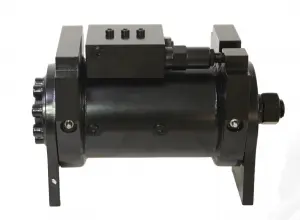
WEITAI WP Series PowerTilt Rotary Actuator
The WEITAI WP Series is designed as a hydraulic tilt solution for excavators and construction attachments. It combines rotary movement, attachment support, hydraulic routing, position holding, and overload protection in an integrated structure.
Its main product features include:
- Integrated hydraulic rotary union
- Reduced external hose routing
- Lightweight structural optimization
- Improved positional locking
- Reinforced sealing and bearing system
- Built-in cross-port pressure relief
- Custom coupler and attachment layouts
The integrated rotary union is intended to simplify the hydraulic path through the tilt mechanism, while the reinforced sealing and bearing structure supports repeated operation in construction environments. The cross-port relief system adds protection when external loads create sudden hydraulic pressure increases.
Flexible Coupler and Attachment Integration
Excavators may use digging buckets, grading buckets, compactors, grapples, rippers, and other attachments. The tilt mechanism must work with the attachment layout without creating unnecessary width or restricting access to the connection points.
The WP Series supports customized coupler layouts for different attachment structures. It can be integrated into PowerTilt assemblies, hydraulic quick couplers, and application-specific connection systems.
The product is also listed as interchangeable with corresponding HELAC applications, although excavator weight, mounting dimensions, hydraulic interfaces, rotation angle, and attachment arrangement should be confirmed for the individual configuration.
Conclusion
This can reduce unnecessary machine repositioning during trench finishing, slope shaping, landscaping, and work around obstacles. Integrated hydraulic routing, stable position holding, overload protection, and attachment compatibility also influence how effectively the tilt function performs in daily operation.
The WEITAI WP Series combines these functions in a range designed for excavators from compact machines to heavier construction equipment. With 140-degree and 180-degree configurations, integrated rotary-union design, reinforced sealing and bearings, and flexible coupler layouts, the series provides a compact hydraulic tilting structure for multi-angle excavation work.
Frequently Asked Questions
1、What is the WP Series Rotary Actuator mainly used for?
It is mainly used in excavator PowerTilt systems, hydraulic tilt couplers, grading buckets, trenching attachments, and other construction mechanisms requiring controlled side-to-side tilt.
2、How does a PowerTilt actuator reduce excavator repositioning?
It allows the attachment angle to change independently from the excavator arm, helping the bucket follow slopes, trench walls, and uneven surfaces without moving the complete machine as frequently.
3、What rotation angles are available in the WP Series?
The WP Series includes 180-degree configurations for several compact and medium models and 140-degree configurations for larger models.
4、Why is an integrated hydraulic rotary union useful?
It routes hydraulic flow through the tilt structure, reducing exposed hose loops and simplifying the hydraulic connection to couplers and powered attachments.
Post time: Aug-06-2026