
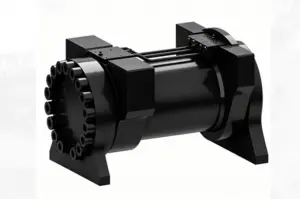
A PowerTilt Rotary Actuator works between the excavator stick and attachment, where it must rotate the tool, hold its angle, transfer load, and tolerate repeated hydraulic cycling.
Because of this, torque and rotation angle alone cannot describe actual performance. Hose movement, internal leakage, bearing clearance, pressure spikes, attachment weight, and mounting geometry can all affect long-term operation.
A practical way to evaluate a PowerTilt is to start with common operating problems and identify the design factors behind them.
Common PowerTilt Problems and Likely Causes
| Problem | Possible Cause | Key Design Area |
|---|---|---|
| Attachment angle drifts after stopping | Internal leakage, clearance, insufficient holding ability | Seals, bearings, positional locking |
| Hoses wear repeatedly | Bending, rubbing, twisting | Hydraulic routing |
| Rotation feels harsh | Excessive flow or pressure spikes | Flow and pressure protection |
| Position accuracy declines | Bearing or seal wear | Bearing and sealing system |
| Attachment end becomes too heavy | Heavy actuator or coupler | Structural weight |
| Impact causes hydraulic shock | Sudden external load | Cross-port relief |
| New attachment changes performance | Different load geometry | Coupler layout |
These problems are often connected. Bearing wear, for example, can increase clearance, which may affect seal loading and eventually reduce holding stability.
Holding Performance Is Different from Drive Torque
A PowerTilt may rotate a bucket easily but still allow the attachment angle to change once the bucket contacts the ground.
During grading or slope work, external forces remain after rotation stops. Soil resistance, attachment weight, and machine movement continue to act on the actuator.
This means two different capabilities should be considered:
- Drive torque determines whether the attachment can rotate.
- Holding performance determines whether it can maintain the selected angle under load.
For grading, trench shaping, and other precision work, stable position holding can be just as important as rotary force.
Hose Reliability Depends on Movement
Hydraulic hoses around a tilting attachment move every time the actuator rotates.
Poor routing can cause repeated bending, abrasion, twisting, pinching, or excessive tension near the end of travel. Over many cycles, even small contact points can become major wear areas.
An integrated hydraulic rotary union reduces the amount of external hose movement around the rotating structure.
Its main value is not simply a cleaner appearance. It reduces the number of hose sections exposed to repeated bending and mechanical interference.
For high-cycle attachments, hydraulic routing should therefore be evaluated together with the complete rotation path.
Bearings and Seals Affect Each Other
Bearings keep the rotary structure aligned, while seals maintain hydraulic pressure.
When bearing clearance increases, internal components may move slightly from their intended position. This can create uneven seal loading and increase leakage.
A typical progression is:
bearing wear → increased clearance → seal wear → internal leakage → weaker position holding
This is why long-term positioning accuracy depends on both mechanical support and hydraulic sealing.
A reinforced bearing and sealing system is particularly important in applications involving frequent reversing, vibration, external moment loads, and repeated stopping under load.
Impact Pressure Is Not Normal Working Pressure
Excavator attachments frequently encounter sudden loads.
A bucket may strike compacted soil, rock, concrete, or a hidden obstacle. The impact can travel through the attachment and create a short hydraulic pressure spike inside the rotary actuator.
This is different from normal system pressure because it is caused by an external mechanical event rather than controlled hydraulic operation.
A built-in cross-port pressure relief structure helps manage excessive pressure differences between actuator ports during these sudden events.
It does not replace correct hydraulic system settings, but it provides additional protection close to the component receiving the impact.
Attachment-End Weight Matters
A PowerTilt is installed at the end of the excavator stick, so its weight has a greater effect than the same mass positioned closer to the machine.
Excessive attachment-end weight can influence:
- Available attachment capacity
- Stick-end inertia
- Machine balance
- Hydraulic response
- Pin and coupler loads
Lightweight design should therefore mean removing unnecessary mass while maintaining enough strength for torque transmission, pressure containment, bearing support, and structural load.
This is especially important on compact and medium excavators.
Rated Rotation Is Not Always Usable Rotation
A larger rotation angle is useful only if the complete attachment system can actually use it.
Real working range may be limited by:
- Hose routing
- Coupler dimensions
- Bucket geometry
- Stick interference
- Attachment clearance
If a hose becomes tight or the attachment contacts another structure before the rated angle is reached, the additional theoretical rotation has little practical value.
For this reason, effective rotation should be evaluated across the complete excavator–PowerTilt–coupler–attachment system.
Attachment Compatibility Depends on Geometry
Matching pin dimensions does not automatically mean two attachments will load the rotary actuator in the same way.
Changing the coupler or attachment can alter the rotation center, installation height, center of gravity, working radius, and overall weight.
Two attachments with similar mass can therefore create very different moment loads.
Flexible coupler layouts help adapt the actuator to different attachment geometries while maintaining a suitable connection and rotation position.
For applications corresponding to HELAC-type layouts, mechanical dimensions, hydraulic interfaces, and movement range should all be confirmed rather than relying on external similarity alone.
How the WT Series Addresses These Issues
The WT Series Rotary Actuator combines several design features that correspond directly to these operating problems:
- Integrated hydraulic rotary union to reduce external hose movement
- Lightweight structural optimization to limit attachment-end mass
- Improved positional locking for better angle stability
- Reinforced hardened seals and bearings for repeated operation
- Built-in cross-port pressure relief for overload protection
- Flexible coupler layouts for different attachments
These features are more meaningful when viewed as solutions to specific engineering problems rather than as isolated product advantages.
Conclusion
A PowerTilt Rotary Actuator should be evaluated as part of the complete excavator attachment system.
Several practical conclusions are especially useful:
- Drive torque and holding performance should be evaluated separately.
- Hose reliability depends on motion and routing, not pressure alone.
- Bearing wear can influence sealing and positioning accuracy.
- Impact pressure is different from normal working pressure.
- Attachment-end weight can significantly affect machine behavior.
- Usable rotation depends on the complete attachment geometry.
These factors provide a more useful basis for understanding PowerTilt performance in grading, trenching, slope shaping, landscaping, and other excavator applications.
Frequently Asked Questions
Why does a PowerTilt attachment drift after stopping?
Possible causes include internal leakage, increased bearing clearance, excessive moment load, or insufficient holding capability.
Is a larger rotation angle always better?
No. The useful angle depends on hose routing, coupler dimensions, bucket geometry, and possible structural interference.
Why can changing the bucket affect PowerTilt performance?
Different bucket widths, centers of gravity, coupler heights, and working radii can change the moment load on the actuator even when total weight is similar.
What is the benefit of an integrated hydraulic rotary union?
It reduces external hose movement around the rotating section, helping lower the risk of rubbing, twisting, and repeated bending.
Post time: Aug-13-2026