
A Hydraulic Valve Actuator is used where quarter-turn valves need reliable remote operation, high torque, and stable performance under demanding working conditions. This is especially important in marine vessels, offshore systems, chemical processing plants, water treatment facilities, and heavy industrial fluid networks, where valves may be large, frequently operated, difficult to access, or installed in environments that make manual control inconvenient.
In these systems, the actuator is not simply a device that turns a valve. It becomes part of the overall fluid-control arrangement, allowing valves to open, close, or change position according to system requirements. A properly selected Hydraulic Valve Actuator can reduce the need for local manual operation, improve control of complex piping networks, and provide the torque required for reliable 90-degree valve movement.
Why Hydraulic Valve Actuators Are Important in Remote Valve Control
Many industrial and marine piping systems contain valves distributed across large areas. Some are located inside machinery spaces, tanks, pump rooms, lower compartments, or process zones where frequent manual access is inefficient or difficult.
A Hydraulic Valve Actuator allows these valves to be integrated into a remote-control system. Hydraulic pressure is transmitted to the actuator, which converts that pressure into rotary motion to operate the valve. This is particularly suitable for quarter-turn valves such as butterfly valves, ball valves, and similar rotary valve structures.
Remote actuation helps solve several common operating problems:
- Valves are located in restricted or difficult-to-access areas.
- Large valves require more torque than convenient manual operation can provide.
- Multiple valves need to be controlled as part of one operating sequence.
- Process conditions require faster or more consistent valve response.
- Local access may be undesirable during abnormal or emergency conditions.
For these reasons, actuator performance has a direct relationship with the reliability of the complete piping system.
How Hydraulic Valve Actuators Support Shipboard VRCS
One of the most important applications for a Hydraulic Valve Actuator is the shipboard Valve Remote Control System, commonly referred to as VRCS.
Modern vessels contain many valves used to control seawater, ballast water, cargo fluids, bilge liquids, and other shipboard media. These valves may be distributed throughout different compartments, making direct manual operation impractical during routine operation.
Hydraulic valve actuation allows operators to control these valves remotely from designated control locations. This is especially useful when multiple flow paths need to be changed quickly or when valves are installed in areas that are difficult to reach during operation.
In a marine VRCS, actuator selection should consider more than valve size. Important factors include required torque, valve rotation, available hydraulic pressure, mounting interface, environmental exposure, and expected operating frequency.
Managing Complex Flow Paths in Cargo Oil Systems
Cargo oil systems on tankers and similar vessels contain complex piping arrangements connecting storage tanks, cargo pumps, manifolds, loading lines, and discharge systems. Changing cargo flow paths requires multiple valves to operate accurately and, in some cases, in a specific sequence.
Hydraulic actuation allows these valves to be controlled remotely without requiring personnel to move between different valve locations during each operation.
In cargo handling systems, Hydraulic Valve Actuators may be used for:
- Cargo tank isolation
- Pump inlet and outlet control
- Manifold flow switching
- Pipeline routing
- Loading and discharge operations
- Remote shutdown functions
Because cargo media and surrounding environments can differ significantly, sealing materials, corrosion protection, and actuator configuration should be matched to actual service conditions.
Improving Valve Accessibility in Bilge Control Systems
Bilge systems collect and transfer liquids from low areas of a vessel, machinery spaces, and other compartments. Valves in these systems are often distributed across areas where direct access may not always be convenient.
Using a Hydraulic Valve Actuator allows these valves to become part of a centralized control arrangement. This reduces dependence on local manual operation and makes it easier to manage critical flow paths from a designated control position.
For bilge service, reliable operation after long periods in one position can be particularly important. The actuator must be capable of producing sufficient breakaway torque when the valve is eventually required to move.
High Torque in Limited Space for Offshore Installations
Offshore installations face many of the same valve-control challenges as ships, but space restrictions, harsh environmental exposure, and maintenance accessibility can be even more demanding.
Large valves may require significant torque, while the available mounting area around pipelines may be limited. A compact Hydraulic Valve Actuator can provide substantial rotary torque without requiring an excessively large installation envelope.
This is useful where actuators must be installed close to:
- Structural steelwork
- Parallel pipelines
- Pumps and process equipment
- Hydraulic manifolds
- Restricted access platforms
High torque density is therefore not simply a performance feature; it can directly affect whether the actuator can be integrated into the available mechanical space.
Hydraulic Valve Actuators in Chemical Process Control
Chemical processing facilities use valves to isolate process sections, redirect fluids, control transfer lines, and manage utility systems. Many of these valves operate under pressure, temperature, or environmental conditions that make reliable remote actuation valuable.
A Hydraulic Valve Actuator can provide the torque needed to operate larger quarter-turn valves while allowing the control function to be integrated into a centralized hydraulic system.
Typical applications include:
- Process line isolation
- Chemical transfer pipelines
- Storage tank systems
- Pumping circuits
- Utility and auxiliary fluid systems
Seal material and actuator protection should be matched to the operating environment. Temperature, surrounding chemicals, external corrosion exposure, and operating frequency can all influence the appropriate configuration.
Stable Valve Automation for Water Treatment Systems
Water treatment plants contain extensive piping systems connecting intake stations, filters, treatment units, pumps, sludge systems, and distribution lines. Larger quarter-turn valves in these networks may require substantial operating torque and repeated movement.
A Hydraulic Valve Actuator can support remote and automated operation of these valves, particularly where centralized process control is required.
Common locations include:
- Main isolation pipelines
- Pump inlet and discharge lines
- Filtration and backwash systems
- Sludge handling networks
- Wastewater process lines
- Large-diameter distribution systems
In water treatment applications, reliable and repeatable valve positioning is often more important than extremely fast movement. The actuator should consistently complete the required rotation and maintain stable operation over repeated cycles.
Meeting High-Torque Demands in Heavy Industrial Pipelines
Heavy industrial facilities often handle large flow rates, high-pressure pipelines, cooling systems, utility fluids, process media, and other demanding services. As valve size and differential pressure increase, manual operation becomes increasingly difficult.
Hydraulic actuation offers high torque in a relatively compact form, making it suitable for larger valves and heavy-duty applications.
For industrial systems, actuator selection should be based on several operating conditions rather than valve diameter alone:
- Valve breakaway torque
- Running torque
- Required rotation angle
- Maximum differential pressure
- Available hydraulic pressure
- Desired operating speed
- Mounting flange and shaft dimensions
- Environmental and temperature conditions
Correct actuator sizing helps ensure reliable valve movement without unnecessary oversizing.
Why Valve Stem Load Matters in Actuator Design
Torque output is important, but the way torque is transmitted to the valve is also important.
If an actuator introduces excessive lateral force or bending load into the valve spindle, additional mechanical stress can be transferred to the valve stem, packing, seats, and sealing components. Over repeated cycles, this may contribute to uneven wear and increased operating resistance.
A balanced rotary actuator design can help reduce unwanted side loading while transmitting the required rotary torque. This is especially useful for valves that operate frequently or where maintaining stable mechanical alignment is important.
The actuator and valve should therefore be considered as one mechanical assembly rather than two independent components.
WEITAI Hydraulic Valve Actuator Solutions
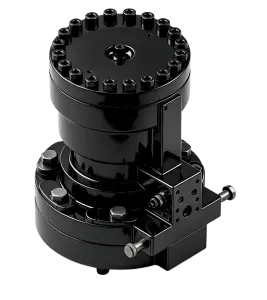
For marine, offshore, and industrial valve-control applications, WEITAI provides the WBRC Series Hydraulic Valve Actuator, developed for 90-degree quarter-turn valve operation. The series uses a double-acting balanced rotary structure designed to provide high torque from a compact actuator body while reducing unnecessary side loading on the valve spindle.
Depending on the actual application, WEITAI can support actuator configuration around several key requirements:
- Valve operating torque and 90-degree rotation
- Valve stem and mounting-interface matching
- Marine and offshore environmental conditions
- Seal configurations for different service conditions
- Surface protection and coating requirements
- Hydraulic control block integration
- Existing-system replacement and dimensional matching
For shipboard applications, the actuator can be integrated into Valve Remote Control Systems used in ballast systems, cargo oil handling, bilge control, and other marine piping networks. For industrial applications, the same actuator platform can be adapted for chemical processing plants, water treatment systems, and heavy-duty fluid-control networks.
Matching the Actuator to the Complete Valve System
A suitable Hydraulic Valve Actuator should not be selected only according to nominal valve diameter. The actuator needs to match the actual torque demand, valve interface, hydraulic supply, operating environment, control method, and available installation space.
For new projects, actuator configuration can be developed around valve data and system operating conditions. For replacement applications, existing mounting dimensions, hydraulic interfaces, actuator footprint, and control connections should also be checked to reduce unnecessary system modification.
The objective is to provide a valve actuation solution that delivers the required torque, completes the full quarter-turn movement, integrates with the available control system, and remains suitable for the operating environment over repeated service cycles.
FAQ
Where are Hydraulic Valve Actuators commonly used in marine systems?
They are commonly used in Valve Remote Control Systems, ballast systems, cargo oil handling networks, bilge systems, and other shipboard piping applications where valves need to be controlled from a remote location.
What information is needed to select a Hydraulic Valve Actuator?
Important information includes valve type, breakaway torque, running torque, required rotation angle, valve stem dimensions, mounting interface, available hydraulic pressure, operating environment, and control requirements.
Why is hydraulic actuation suitable for large quarter-turn valves?
Hydraulic systems can generate high rotary torque within a relatively compact actuator size. This makes hydraulic actuation useful for larger valves or applications where available installation space is limited.
Can Hydraulic Valve Actuators be used in both marine and industrial systems?
Yes. Hydraulic valve actuators can be used in shipboard and offshore systems as well as chemical processing, water treatment, and heavy industrial fluid-control networks. The actuator configuration should be adapted to the valve, environment, hydraulic system, and control requirements of each application.
Post time: Aug-26-2026