
Choosing among Hydraulic Tilt Coupler Manufacturers involves more than comparing price, excavator tonnage, or maximum tilt angle. A hydraulic tilt coupler sits between the excavator arm and the attachment, so its design directly affects bucket movement, attachment geometry, hydraulic routing, locking, structural load, and the amount of repositioning required during work.
For excavator manufacturers, attachment brands, and equipment integrators working with a China OEM, the key question is whether the manufacturer can turn machine data into a complete tilt solution. The coupler needs to fit the carrier, work with the hydraulic system, maintain attachment clearance, withstand digging loads, and operate reliably through repeated tilt and attachment-change cycles.
Key Considerations Before Finalizing an OEM Tilt Coupler Design
A hydraulic tilt coupler should not be selected from excavator tonnage alone. Machines in the same weight class can use different pin sizes, dipper widths, mounting centers, hydraulic systems, and attachment interfaces.
The application itself also matters. Grading, ditch cleaning, slope shaping, landscaping, trench finishing, and work near walls place different demands on attachment movement.
Before an OEM design is finalized, several areas normally need to be understood:
Machine Specifications: Excavator model and carrier size
Mounting & Interfaces: Dipper-end mounting arrangement, attachment, and bucket interface
Performance Requirements: Required tilt range and typical attachments used with the coupler
Hydraulics & Safety: Hydraulic supply available on the machine, quick-coupler locking arrangement, plus working environment and load conditions
The purpose is not simply to collect specifications. The goal is to make sure the coupler works as part of the excavator linkage rather than behaving like an added component that changes the machine in undesirable ways.
How a Hydraulic Tilt Coupler Optimizes Machine Efficiency
The practical purpose of a Hydraulic Tilt Coupler is to give the attachment another controlled movement.
With a fixed bucket connection, angled grading or trench-side finishing often requires the operator to reposition the entire excavator. A tilt coupler allows the bucket or attachment to change angle from the cab, which can make it easier to follow slopes, clean both sides of a ditch, shape edges, and work around obstacles.
However, a larger nominal tilt angle does not automatically create a better working result.
The coupler also adds structure between the stick and attachment. If this structure becomes too tall, wide, or heavy, it can affect clearance and bucket geometry. A good design therefore tries to gain useful tilt movement without unnecessarily increasing the distance between the excavator arm and the attachment.
This is one reason compact structure matters in real excavation work: it helps preserve the machine’s original working geometry while adding another degree of movement.
Critical Engineering Factors in Hydraulic Tilt Coupler Design
Load-Bearing Capabilities vs. Rotation Angle
Generating tilt movement is only part of the job.
When a bucket is grading at an angle, the tilt mechanism may also experience bending, side loading, shock, and holding loads. The coupler therefore needs to move the attachment and keep it stable while the excavator is actually working.
An integrated hydraulic rotary actuator can provide tilt movement within a compact structure while also supporting the attachment around the rotating connection. Compared with an arrangement that relies on multiple exposed linkage components, an integrated structure can reduce the number of external moving parts around the tilt axis.
For an OEM project, the important questions are not only “How many degrees does it tilt?” but also:
Can the actuator hold the attachment at the required angle under load?
How are external loads supported through the structure?
How are sealing and bearing surfaces protected during repeated movement?
What happens when the attachment receives a sudden impact?
These questions reveal more about real working capability than tilt angle alone.
Optimizing Hydraulic Routing to Reduce Maintenance
Hydraulic hoses around a moving attachment are exposed to a difficult environment. Dirt, rock, bucket movement, abrasion, impact, and repeated bending can all affect hose life.
A tilt coupler creates an additional challenge because hydraulic flow may be required for both the tilt function and the quick-coupler mechanism while the assembly is changing angle.
An integrated rotary union can route hydraulic flow through the tilting structure and reduce the need for large exposed hose loops around the rotation point. This can make the installation cleaner and reduce hose movement in a vulnerable area.
When comparing Hydraulic Tilt Coupler Manufacturers, it is useful to look beyond the actuator itself and consider how the complete hydraulic path works through the full tilt range. Hose protection, routing space, accessibility, and serviceability can have a direct effect on downtime once the attachment enters daily use.
Integrated Locking Mechanisms & Overload Protection
A tilt coupler is still responsible for keeping the attachment connected to the excavator. The addition of tilt movement makes reliable locking even more important.
During digging, grading, and frequent direction changes, the attachment connection must remain stable. The locking arrangement should therefore be treated as part of the complete coupler design rather than added after the tilt mechanism is finished.
The tilt circuit also needs to deal with unexpected loads. A bucket may strike hard soil, rock, or another obstacle while working at an angle. These events can create sudden hydraulic pressure increases inside the actuator.
Cross-port relief protection provides a way to relieve abnormal pressure when an external load exceeds normal operating conditions. Its purpose is not to increase working torque, but to help protect the hydraulic tilt mechanism from shock loads that occur in real construction environments.
Evaluating China OEM Capabilities Beyond Basic Fabrication
Many factories can weld and machine steel components. That alone does not make them suitable Hydraulic Tilt Coupler Manufacturers for OEM projects.
A true OEM project often requires changes to the upper mounting structure, lower coupler interface, width, pin arrangement, hydraulic connections, tilt mechanism, or attachment compatibility. Changing one of these areas can affect another, so customization requires engineering control rather than simply modifying dimensions.
This is particularly important when an attachment brand wants to develop one product family for several excavator classes. The basic tilt concept may remain similar, but carrier interfaces, structural loads, attachment dimensions, and actuator requirements change as machine size increases.
A useful China OEM should therefore be able to support:
Application-based structural adjustment
Different excavator and attachment interfaces
Hydraulic integration & coupler configuration changes
Prototype development & production based on drawings or application requirements
The ability to make these changes consistently is more important than offering a very long list of nominal models.
WEITAI Hydraulic Tilt Coupler OEM Solutions
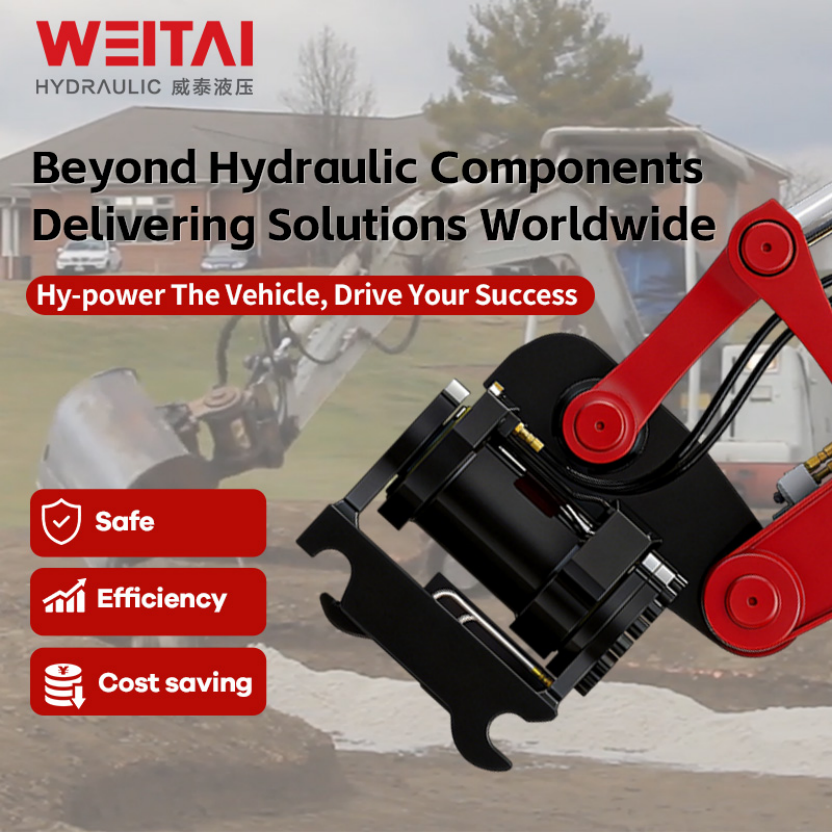
WEITAI develops Hydraulic WPT Power Tilt solutions for excavator attachments through its WPT product range, including WP, WT, and WBV series for different excavator applications. The current WPT07 Hydraulic Tilt Coupler is designed for excavators and combines a 180° total tilt range with an integral rotary union, improved holding force, hardened seal and bearing surfaces, integrated cross-port relief protection, and multiple coupler configurations.
The wider Power Tilt range is designed around integrated hydraulic rotary actuation. Current WEITAI information describes applications from compact to heavier excavators, with WP / WT / WBV configurations covering different machine sizes and 140° or 180° tilt arrangements depending on the series.
For OEM projects, the tilt mechanism can be combined with different coupler and attachment layouts. This allows the solution to be developed around the excavator mounting structure, attachment interface, hydraulic requirements, and required tilt movement rather than treating every machine as the same application.
What Should You Expect From a China Hydraulic Tilt Coupler OEM?
A good OEM relationship should result in more than a coupler that matches a drawing.
The finished solution should help the excavator gain useful multi-angle attachment movement without creating unnecessary interference, exposed hydraulic complexity, or unreliable attachment connection. It should also be possible to adapt the design when different excavator classes or attachment interfaces are involved.
When evaluating Hydraulic Tilt Coupler Manufacturers, the most useful indicators are therefore practical engineering capability, complete hydraulic and mechanical integration, repeatable testing, and the ability to develop variations around real machine applications.
A well-designed hydraulic tilt coupler ultimately gives the excavator more freedom to grade, shape, clean, and finish from different angles while reducing unnecessary machine repositioning.
Frequently Asked Questions (FAQ)
Q What information does a Hydraulic Tilt Coupler Manufacturer need for an OEM project?
Typical information includes excavator model, machine size, mounting geometry, attachment interface, hydraulic supply, required tilt range, expected attachments, and working conditions. This allows the coupler to be developed around the actual carrier rather than a generic size category.
Q Why is an integrated rotary union useful in a Hydraulic Tilt Coupler?
It allows hydraulic flow to pass through the tilting structure while reducing exposed hose movement around the rotation point. This can simplify hydraulic routing and help protect hoses in an area exposed to repeated attachment movement.
Q What is the purpose of cross-port relief protection?
When an attachment receives an unexpected external load, hydraulic pressure inside the tilt circuit can rise suddenly. Cross-port relief protection helps relieve excessive pressure and protect the tilt mechanism from abnormal shock loads.
Q Can a China OEM develop Hydraulic Tilt Couplers for different excavator sizes?
Yes. A manufacturer with engineering and production capability can adapt mounting structures, actuator sizes, coupler interfaces, hydraulic routing, and other details for different carrier classes while maintaining the same overall Power Tilt concept.
Post time: Aug-28-2026
Write your message here and send it to us