
A Hydraulic Rotary Actuator for Aerial Lifts is used where a platform, basket, jib or upper structure needs controlled angular movement without the complexity of a large external rotation mechanism. In aerial equipment, however, simply creating rotation is not enough. The movement must remain predictable while the working structure carries people, tools and changing external loads at height.
This changes the way the actuator should be evaluated. Maximum rotation speed is rarely the main objective. Controlled starting, smooth stopping, structural support, position stability and compact integration are usually more important because even a small rotational disturbance at the actuator can become more noticeable at the end of an extended boom or jib.
Hydraulic Rotary Actuator for Aerial Lifts Supports Limited-Angle Positioning
A Hydraulic Rotary Actuator for Aerial Lifts is particularly suitable when the machine needs to move through a defined angular range rather than rotate continuously.
Platform rotation, basket adjustment, jib positioning and certain steering functions usually involve moving between working positions, stopping, holding the selected angle and then changing position again when required.
This differs from a hydraulic motor used for continuous rotation. The aerial lift does not necessarily need unlimited revolutions. Instead, it needs a predictable angular movement that can be integrated into the machine structure and hydraulic system.
This is why limited-angle rotary actuators can provide a practical solution where compactness and controlled positioning matter more than continuous speed.
Movement at Height Amplifies Poor Rotation Quality
A small amount of harsh movement near the actuator may feel much larger to an operator standing several meters away from the rotation axis.
As the platform or basket moves farther from the pivot point, sudden acceleration and stopping become increasingly noticeable. Mechanical backlash, abrupt valve response or excessive rotation speed can therefore affect operator confidence even when the actuator itself appears to be functioning normally.
For this reason, aerial lift rotation should be judged by movement quality rather than only by the time required to complete the angle.
A slightly slower but smoother movement may produce a better machine than an actuator that reaches position quickly but creates uncomfortable starts and stops.
The objective is stable positioning with predictable response throughout the required rotation range.
The Load Is Not Just the Weight of the Basket
Actuator selection becomes more complex because the rotating load is rarely concentrated directly at the rotation axis.
A basket, jib or platform extends away from the actuator. The farther its center of gravity sits from the pivot, the greater the moment acting on the rotary mechanism.
The actual working load may also change. Operators, tools, materials and platform accessories can shift the center of gravity and increase the torque required to start or hold the movement.
Wind can add another external influence in elevated applications. Even when the static weight remains unchanged, an extended structure can experience changing external moments.
This means actuator selection should consider the load through the real working geometry rather than using only the nominal platform weight.

Drive Torque and Position Holding Are Separate Requirements
Aerial lift rotation has two distinct operating states.
During movement, the actuator needs enough drive torque to rotate the platform or structure against gravity, friction and other resistance. After the movement stops, the same structure may continue applying an external moment to the actuator.
The second condition is easy to underestimate. A component that can successfully move the platform may still be unsuitable if the mechanism does not remain stable after the control command ends.
For aerial equipment, this becomes especially important because the operator may remain at one angle for much longer than the actuator spends rotating.
The actuator and hydraulic circuit should therefore be evaluated for both movement and holding behavior, not only maximum drive torque.
Rotation Speed Must Match the Working Radius
Flow determines how quickly a hydraulic rotary actuator moves through its available angle. More flow can shorten rotation time, but increasing speed is not automatically beneficial.
The farther the operator platform is from the rotation axis, the more noticeable angular speed becomes at the outer edge of the structure. A rotation rate that feels moderate near the actuator can translate into significantly faster linear movement at the basket.
This is why aerial lift motion should be evaluated from the operator’s position rather than only from the actuator shaft.
The hydraulic system should provide enough flow for efficient positioning without creating excessive acceleration or making the final approach difficult to control.
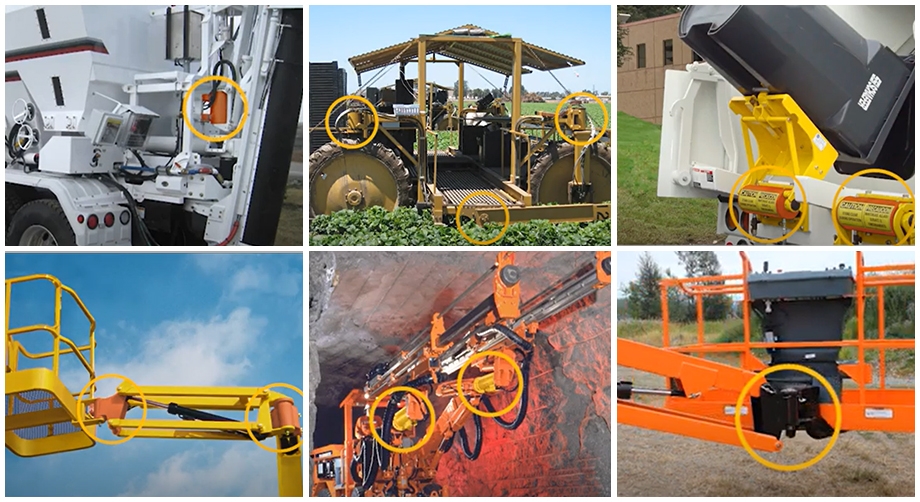
Aerial Lift Rotary Systems Should Be Checked as a Complete Load Path
Before choosing a rotary actuator, several conditions should be considered together:
● Required platform, basket or jib rotation angle
● Maximum working load and center-of-gravity location
● Required drive torque and position-holding condition
● Radial, axial and overturning loads acting on the actuator
● Available hydraulic pressure and flow
● Desired rotation time and stopping behavior
● Mounting structure and support arrangement
● Installation space around hoses and nearby components
These conditions provide a more realistic basis for selection than comparing actuator torque alone.
Mounting Method Matters More in Safety-Critical Applications
Once installed, the rotary actuator becomes part of the structural path between the machine and the rotating load.
A cantilever arrangement supports the load from one side of the actuator shaft. This can be suitable in some general machinery applications, but an extended platform or basket may create a significant bending moment.
A straddle-supported arrangement supports the rotating load at both sides of the shaft and can reduce the amount of external bending load carried by the actuator itself.
The correct mounting method depends on the complete machine structure, but aerial equipment deserves particular attention because the actuator may be supporting a structure that extends well away from the rotation axis.
Mounting should therefore be evaluated together with load moment, not treated as an installation detail after the actuator has already been selected.
Counterbalance Control Can Matter During Load Changes
Aerial platform movement can involve external loads that try to continue rotating the mechanism even after commanded flow decreases.
When gravity or another load assists the movement, simply reducing pump flow may not be enough to keep the rotation stable. The load can attempt to drive the actuator instead of being driven by it.
This is why hydraulic load control can become important in rotary applications. A properly configured control arrangement helps manage overrunning loads and can also provide additional protection if hydraulic conditions change unexpectedly.
The exact valve strategy depends on the actuator and machine circuit, but the important point is that rotary stability is influenced by both the mechanical actuator and the hydraulic control around it.
Smooth Starting and Stopping Matter More Than Peak Rotation Speed
Aerial lifts typically spend relatively little time rotating compared with the amount of time they spend positioned for work.
This means there is limited value in optimizing the actuator for the fastest possible movement if the result is poor control.
A more practical target is a consistent movement profile: the platform begins rotating without a sudden jump, moves at a predictable rate, slows before the target position and stops without noticeable rebound or unwanted movement.
The operator should not need to repeatedly correct the angle because the system overshoots or reacts differently depending on load.
In this type of application, quality of motion is part of productivity because smooth positioning reduces the time spent making small corrections.
Compact Rotary Motion Can Simplify the Upper Structure
Traditional limited-angle mechanisms can use cylinders, external linkage arms, bearings and multiple support components to create rotation.
A helical rotary actuator can generate angular movement directly in a compact unit. When properly integrated, this can reduce the number of external mechanical components around the rotation point.
The benefit is especially relevant to aerial platforms where space is already occupied by boom structures, hydraulic hoses, control lines and safety systems.
A compact rotary solution can give machine designers more freedom to arrange these surrounding systems while maintaining the required movement.
However, compactness should never be evaluated separately from load capacity. The smallest actuator is not necessarily the best actuator if the surrounding structure places large radial or moment loads on it.
Aerial Lifts Need Different Priorities From General Rotary Machinery
A rotary actuator used for conveyor positioning or industrial machinery may prioritize fast cycle time, high output or simple automation.
Aerial equipment places additional emphasis on movement quality and structural behavior because people are working on the moving structure.
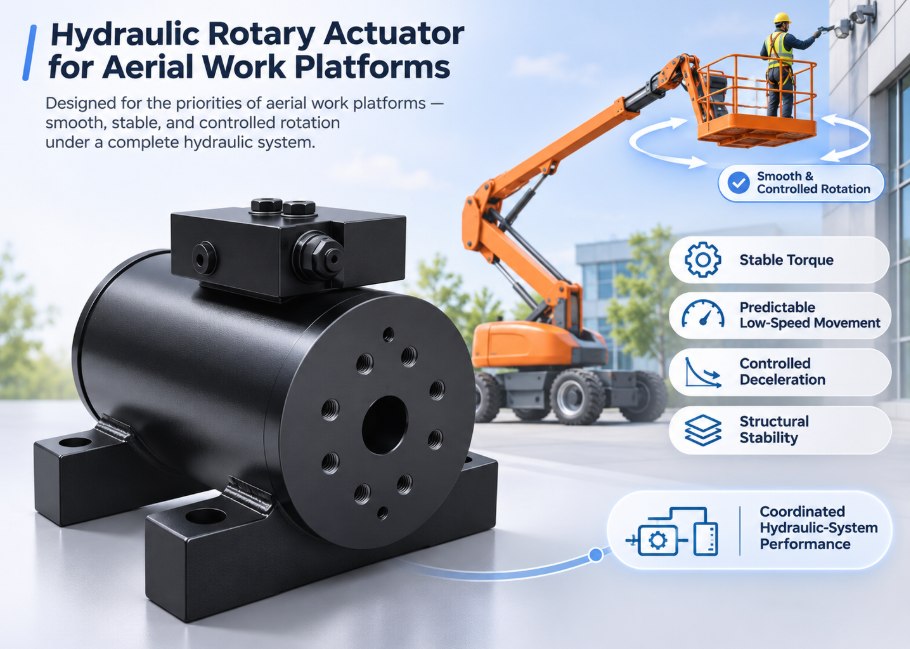
This changes the selection priorities. Stable torque, predictable low-speed movement, controlled deceleration and proper load support often matter more than maximum rotation speed.
The actuator must also work as part of a wider hydraulic system that may simultaneously control lifting, leveling, steering or travel functions.
If available flow changes when another hydraulic function is operated, rotation behavior can also change. OEM design should therefore consider how the actuator performs within the complete machine rather than only during an isolated bench test.
WEITAI Rotary Actuator Solutions for Aerial Lift Applications
For aerial platform applications, WEITAI provides hydraulic rotary actuator solutions that can be evaluated according to the required rotation angle, load, mounting structure, pressure, flow and available installation space.
The WL20 Series is a relevant direction for compact mobile equipment requiring controlled limited-angle rotary movement. In aerial work platform applications, actuator matching should consider not only the torque needed to move the structure but also the mounting arrangement, external load moment and hydraulic control required for smooth positioning.
For larger or different load conditions, another actuator series may be more suitable. The project should therefore be matched from the machine requirements rather than assuming that one actuator size covers every platform.
From Application Information to Configuration and Quotation
For an aerial lift project, useful starting information includes machine type, rotating structure, required angle, maximum working load, distance from the actuator axis to the load center, available pressure and flow, mounting arrangement and available installation space.
For replacement projects, the original actuator model and drawings are also useful because they help identify the existing interface and hydraulic requirements.
With this information, WEITAI can evaluate whether a WL20 configuration or another rotary actuator direction is appropriate for the machine.
Conclusion
A Hydraulic Rotary Actuator for Aerial Lifts should not be selected simply by maximum torque or rotation speed. Aerial equipment places additional importance on smooth motion, position stability, structural support and predictable behavior under changing load.
The platform working radius, center of gravity, mounting arrangement and hydraulic control all influence how the actuator feels at height. A rotary actuator that moves the structure successfully may still be a poor match if it starts abruptly, creates excessive bending load or cannot maintain a stable working position.
For OEM and replacement projects, the best actuator is therefore the one that fits the complete movement and load path of the aerial lift—not simply the one with the largest torque number.
FAQ
What does a Hydraulic Rotary Actuator for Aerial Lifts control?
It can be used for controlled angular functions such as platform, basket or jib rotation, depending on the design of the aerial lift.
Is a faster rotary actuator better for an aerial work platform?
Not necessarily. Smooth starting, predictable low-speed movement and controlled stopping are often more important than maximum rotation speed because sudden movement becomes more noticeable at the working platform.
How much does a Hydraulic Rotary Actuator for Aerial Lifts cost?
Price depends on torque requirement, rotation angle, mounting configuration, load capacity, hydraulic control requirements, customization and order quantity. Providing machine and load information allows WEITAI to evaluate a suitable configuration and quotation.
Can WEITAI provide a replacement rotary actuator for an aerial lift?
A replacement or alternative can be evaluated, but rotation angle alone is not enough to confirm compatibility. Mounting dimensions, load capacity, hydraulic interfaces, available pressure and flow, and the original actuator information should also be checked.
Post time: Nov-16-2026