
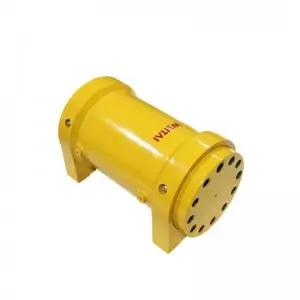
A 180 Degree Hydraulic Rotary Actuator is designed for machines that need controlled half-turn rotation rather than continuous 360° motion. It produces rotary movement directly, avoiding the need to convert linear cylinder motion through external linkage, arms, or other mechanical arrangements. This makes it especially useful where installation space is limited and the machine requires compact, controlled angular positioning.
However, the 180° rotation range is only the starting point. Actual performance also depends on torque throughout the movement, load center of gravity, holding requirements, external load moments, rotation speed, mounting geometry, and available hydraulic pressure and flow. A suitable actuator should therefore be selected around the complete movement and load path rather than rotation angle alone.
Why Use a 180 Degree Hydraulic Rotary Actuator?
Not every machine requires continuous rotation. Many mobile and industrial machines only need to move between two defined working positions, tilt an attachment, change the orientation of a work tool, or rotate a structure through a limited angle.
In these applications, a 180 Degree Hydraulic Rotary Actuator can reduce unnecessary mechanical complexity. A defined rotation range can simplify hydraulic hose routing, machine control logic, mechanical stops, and surrounding structure compared with a system designed for continuous rotation.
The key question is whether the machine’s complete operating range—including installation tolerance and end positions—fits within the available 180°. If the application repeatedly needs to move beyond this range, a different actuator architecture may be more appropriate.
Torque Requirement Changes During Rotation
One common selection mistake is to calculate torque at only one position.
When a rotary actuator moves an offset load around a horizontal axis, the moment created by gravity changes as the load moves through the arc. The highest torque requirement may occur in the middle of the movement rather than at either end.
A simplified relationship is: Load Torque ≈ Load Force × Distance from Rotation Axis
This means a relatively light attachment positioned far from the rotation axis can create a higher torque requirement than a heavier load located closer to the actuator. Platforms, booms, clamps, work tools, and other offset structures should therefore be evaluated through the complete 180° movement.
Dynamic behavior also matters. Starting a rotating mass requires acceleration, while rapid stopping creates additional load. For this reason, selection should consider starting, steady rotation, deceleration, and stopping rather than relying on one static torque value.
Drive Torque and Holding Torque Are Different
A 180 Degree Hydraulic Rotary Actuator may need to perform two separate tasks: move the load and hold it in position.
Drive Torque determines whether the actuator can rotate the load under hydraulic power. Holding Torque relates to the actuator’s ability to resist external forces that try to rotate the load after movement has stopped.
This distinction becomes important in equipment such as aerial work platforms, material-handling machines, excavator attachments, and truck-mounted systems. Even after the actuator stops moving, gravity, vibration, wind load, or tool reaction may continue to apply a rotational force.
For this reason, actuator selection should consider both movement and position holding. A unit that provides enough drive torque may still be unsuitable if the application creates significant external load after the actuator reaches its working position.
Load Moment Can Be as Important as Rotary Torque
In many machines, the actuator is not only responsible for rotation. It also supports the attached structure.
When an attachment or platform extends away from the rotation axis, the actuator may experience radial load, axial load, and cantilever or overturning moment. These structural loads can be significant even when the required rotary torque is moderate.
For example, a long attachment with moderate weight may create a large bending moment because its center of gravity is far from the actuator. Selecting only by torque could therefore result in sufficient rotational performance but inadequate structural load capacity.
For equipment where the rotary actuator also supports the load, Drive Torque, Holding Capability, and Load Moment should be evaluated together.
How Does Hydraulic Flow Affect 180° Rotation Speed?
Hydraulic Pressure and Flow influence different aspects of actuator performance. Pressure supports available torque, while Flow determines how quickly the actuator moves through its angular range.
If the machine needs to complete a 180° movement quickly, the hydraulic system must provide sufficient flow. However, faster movement is not always better. A heavy attachment or a load with a large center-of-gravity offset can be difficult to stop smoothly if rotation speed is too high.
Rapid acceleration and deceleration can increase shock loading on the actuator, mounting structure, attachment, and hydraulic circuit. A more useful design target is therefore not simply maximum speed, but the required time to complete the movement while maintaining stable control.
For repeated positioning applications, Rotation Time may directly affect Cycle Time. For heavier equipment, controlled and predictable motion may be more important than the fastest possible rotation.
Why Should End-of-Rotation Behavior Be Considered Early?
A 180° actuator has a defined end position, so the machine should be designed to approach that position under control.
If a rotating load with high inertia reaches the end of travel too quickly, deceleration can create large transient loads. Repeated impact at the end position may increase stress on the actuator and machine structure.
The hydraulic circuit and control strategy should therefore manage acceleration and deceleration rather than relying on the mechanical end position to absorb all motion energy. Depending on the machine, this may involve Flow Control, Proportional Control, external stops, or other motion-management methods.
The goal is not simply to reach 180°, but to reach the final position smoothly and repeatedly.
Why Does Mounting Geometry Matter?
A 180 Degree Hydraulic Rotary Actuator becomes part of the machine’s load path once installed. Mounting therefore affects more than whether the actuator physically fits.
The actuator axis should align correctly with the machine’s intended rotation axis. Misalignment can introduce unnecessary side loads and additional stress into the actuator and surrounding structure. The mounting frame must also be stiff enough to transfer torque and external moments without excessive deformation.
Different machines may require Foot Mounting, Flange Mounting, or different Output Interfaces. For OEM equipment, it is generally better to define mounting geometry early in the design process rather than choosing an actuator first and modifying the machine afterward.
Which Applications Benefit from 180° Rotation?
A 180° rotary actuator is particularly useful where equipment needs controlled orientation changes rather than continuous rotation.
Typical applications include aerial work platforms, truck-mounted equipment, material-handling machinery, excavator attachments, construction equipment, and other mobile machines requiring compact rotary positioning.
These applications usually have several requirements in common:
- · Controlled limited-angle rotation
- · Load support
- · Position holding
- · Compact installation
- · Integration with the machine’s hydraulic and mechanical systems
The rotation angle answers only “how far must it move.” Torque, load moment, holding capability, speed, and mounting determine whether the actuator can perform that movement reliably.
WEITAI 180 Degree Hydraulic Rotary Actuator Solutions
WEITAI provides several Helical Hydraulic Rotary Actuator series for different machine classes, load conditions, mounting requirements, and hydraulic systems. For equipment requiring 180° limited rotation, the selection focus is not simply higher torque. The actuator should match the machine’s output requirement, Holding Performance, Load-Bearing Capability, installation structure, and hydraulic conditions.
For OEM projects, WEITAI can evaluate the application based on Machine Drawings, Mounting Dimensions, Load Information, Hydraulic Pressure and Flow, Target Rotation Time, and Operating Conditions. This makes it possible to consider rotary performance, structural loading, installation compatibility, and hydraulic matching together.
Conclusion
A 180 Degree Hydraulic Rotary Actuator is well suited to equipment that requires controlled half-turn movement combined with compact installation, load support, and position holding.
The 180° rotation range is only one part of the selection process. Actual performance depends on torque variation throughout the motion, holding requirements, external load moment, rotation speed, mounting geometry, and hydraulic-system capability.
Evaluating these conditions together allows the actuator to be selected according to the machine’s real movement and load path rather than a single torque figure.
Contact WEITAI for 180 Degree Hydraulic Rotary Actuator Selection and Quotation
If your project requires an OEM 180 Degree Hydraulic Rotary Actuator, Replacement Solution, Wholesale Supply, or a Hydraulic Rotary Actuator manufacturer in China, WEITAI can evaluate the configuration according to the actual machine and operating requirements.
To request a 180 Degree Hydraulic Rotary Actuator quotation, provide the required rotation angle, load information, center-of-gravity position, Hydraulic Pressure and Flow, Mounting Dimensions, Target Rotation Time, Installation Space, and Project Quantity.
Send your machine and application information to WEITAI to evaluate a suitable 180 Degree Hydraulic Rotary Actuator configuration and request a quotation.
FAQ
How much does a 180 Degree Hydraulic Rotary Actuator cost?
The 180 Degree Hydraulic Rotary Actuator price depends on actuator size, load-bearing requirements, mounting configuration, output interface, hydraulic-control requirements, customization, and order quantity. Standard and OEM configurations may therefore have different pricing.
How can I get a quotation for a 180 Degree Hydraulic Rotary Actuator?
Provide the machine type, rotation requirement, load information, mounting dimensions, hydraulic conditions, installation space, and quantity. Drawings or information from an existing actuator can also help speed up configuration evaluation.
Can a 180 Degree Hydraulic Rotary Actuator be customized for OEM equipment?
Yes. OEM projects may require changes to the Mounting Interface, Output Connection, Hydraulic Port arrangement, Rotation Configuration, or other machine-specific dimensions. The final actuator should be matched to the machine layout and operating conditions.
Can WEITAI provide a Replacement or Alternative for an existing Rotary Actuator?
Yes. Replacement or Alternative configurations can be evaluated, but interchangeability should not be assumed from rotation angle or similar appearance alone. The original actuator model, nameplate, Mounting Dimensions, Hydraulic Interface, and operating conditions should be checked before compatibility is confirmed.
Post time: Oct-21-2026