
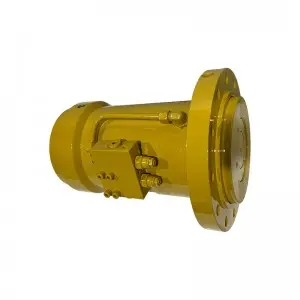
A Hydraulic Rotary Actuator is used when a machine needs powerful rotary motion in a compact space. Unlike a long linear cylinder that requires extra linkage to create rotation, a helical rotary actuator can generate controlled angular movement directly from hydraulic pressure. The WL30 Series 4700Nm Hydraulic Rotary Actuator is designed for heavy-duty applications where rotation, torque holding, load capacity, and mounting reliability all matter.
Why compact rotation is difficult in heavy equipment
Heavy machinery often has very little space for rotation mechanisms. A boom, attachment, platform, steering structure, or trailer component may need to rotate under load, but the equipment frame may not allow a large gearbox, exposed linkage, or long cylinder arrangement. In these conditions, compact hydraulic rotary motion becomes valuable. A Hydraulic Rotary Actuator can place high torque rotation inside a shorter housing, helping designers reduce external moving parts and improve machine layout.
WL30 Series torque range and 4700Nm model
The WL30 Series is a heavy-duty helical hydraulic rotary device with torque output covering demanding machine requirements. The 4700Nm model provides drive torque at 21 MPa and is suitable for equipment that needs controlled rotation rather than continuous high-speed spinning. It can be selected with 180-degree or 360-degree rotation, allowing the same actuator family to support different motion requirements. For applications that need only limited angular positioning, 180-degree rotation may be enough. For machines requiring full turning movement, 360-degree rotation can provide greater flexibility.
Holding torque and load support
In many machines, the actuator must not only rotate a load but also hold it in position. Holding torque is therefore just as important as drive torque. The WL30 4700Nm actuator has a holding torque of 12000Nm at 21 MPa. This is useful when the machine must resist external forces after reaching position. For example, a boom-mounted attachment, steering assembly, platform, or handling device may be exposed to gravity, shock, vibration, or side loads. A rotary actuator with strong holding performance helps maintain position more reliably.
Moment capacity, radial capacity, and axial capacity
Rotary actuators in heavy equipment often receive more than pure torque load. They may also face cantilever loads, straddle loads, radial loads, and axial loads. The WL30 4700Nm actuator provides a maximum cantilever moment capacity of 11900Nm, straddle moment capacity up to 30800Nm for 180-degree rotation and 45400Nm for 360-degree rotation, radial capacity of 3600 kg, and axial capacity of 2700 kg. These values are important for buyers because the actuator is often part of a structural load path, not just a motion device.
Where Hydraulic Rotary Actuator is commonly used
A Hydraulic Rotary Actuator can be used in agriculture, construction, energy, marine, material handling, military, mining, truck, and trailer equipment. Typical functions include steering control, boom positioning, platform rotation, attachment rotation, hatch movement, arm rotation, chute positioning, and lifting equipment angle control. The actuator is especially useful where the machine needs strong rotary force, precise angular movement, and compact installation.
Performance under hydraulic pressure
Drive torque and holding torque are closely related to hydraulic pressure. As pressure increases within the allowed range, torque output rises. However, real machine loads can reduce available drive torque, especially when moment loads increase. This means buyers should not select the actuator only by nominal torque. They should also review the load direction, mounting position, working angle, safety factor, hydraulic system pressure, and whether a counterbalance valve is required. A counterbalance valve can be optional for applications that need better load control and position stability.
Interchange and replacement considerations
When replacing an existing actuator, buyers often need dimensional compatibility and performance compatibility at the same time. The WL30 Series is designed to be interchangeable with HELAC, HKS, and MOVECO in suitable applications. Still, replacement should be checked carefully. Rotation angle, torque, mounting pattern, shaft flange, oil port arrangement, valve position, and installation space should be confirmed before ordering. A correct replacement reduces installation time and helps avoid unexpected machine modification.
Conclusion
A Hydraulic Rotary Actuator is a practical solution for heavy-duty machines that need compact, powerful, and controlled rotation. The WL30 Series 4700Nm actuator combines helical rotary structure, 180-degree or 360-degree rotation options, strong holding torque, high load capacity, flange mounting, and optional counterbalance valve. For construction, agriculture, marine, material handling, mining, and truck equipment, it offers a compact way to convert hydraulic power into reliable rotary motion.
FAQ
Q: What is a Hydraulic Rotary Actuator?
A: It is a hydraulic device that converts hydraulic pressure into controlled rotary motion, usually within a defined angle such as 180 degrees or 360 degrees.
Q: What is the torque of the WL30 4700Nm model?
A: The model provides 4700Nm drive torque at 21 MPa and 12000Nm holding torque at 21 MPa.
Q: Where can the WL30 Series Hydraulic Rotary Actuator be used?
A: It can be used in construction, agriculture, marine, material handling, mining, truck, trailer, and energy equipment.
Q: Why is holding torque important?
A: Holding torque helps the actuator keep the load in position after rotation, especially when the equipment faces gravity, vibration, or external force.
Post time: Jul-07-2026