
Accurate positioning is essential for drilling and mining equipment. Before drilling begins, the drill mast, boom, pipe-handling arm, or working attachment must be moved into the correct angle and held securely against changing loads.
These movements often take place in narrow underground spaces, uneven open-pit environments, or mobile equipment frames where installation space is limited. The rotating mechanism may also need to withstand vibration, dust, repeated impact, and heavy off-center loads.
A hydraulic rotary actuator for drilling equipment provides a compact method of rotating and positioning these structures. By converting hydraulic pressure directly into rotary motion, it can replace more complex arrangements based on cylinders, linkages, external bearings, and large mounting brackets.
For high-load drilling and mining applications, this can simplify the machine structure while improving positioning control and load support.
Positioning the Drill Mast Before Operation
A drill mast must be aligned according to the required drilling direction. Depending on the machine, the mast may need to rotate between transport and working positions, adjust to an inclined surface, or move between several drilling points.
The positioning mechanism must perform two different tasks:
- Move the drill structure to the required angle
- Hold the structure steadily while drilling begins
The first task requires sufficient driving torque. The second requires stable load support and resistance to movement caused by gravity, vibration, and drilling reaction forces.
A hydraulic rotary actuator generates torque directly around the rotation axis. This avoids the need to convert the linear movement of a hydraulic cylinder through a long lever or linkage.
Direct rotary output can make the movement more predictable because the actuator is installed close to the actual rotation center. The machine designer does not need to create a large external structure solely to transform cylinder movement into rotation.
Why Conventional Cylinder Linkages Can Be Difficult to Arrange
A hydraulic cylinder can rotate a drill mast by pushing or pulling a lever connected to the mast pivot. This method is widely used, but it can become difficult when space is restricted.
The cylinder requires room for:
- Its complete retracted length
- The full extension stroke
- Movement of the rod end
- Linkage rotation
- Hose routing
- Protection from surrounding equipment
The available force also changes as the linkage angle changes. At some positions, the cylinder may have favorable leverage. At other positions, especially near the beginning or end of movement, the same cylinder force may produce less rotary torque.
This changing mechanical relationship can make the system larger than expected. A higher cylinder force, stronger linkage, or larger mounting bracket may be required to maintain sufficient torque throughout the full movement range.
A helical hydraulic rotary actuator applies rotary torque directly at the output flange. This reduces dependence on external leverage and allows the rotating mechanism to remain more compact.
Supporting Heavy and Off-Center Drilling Structures
A drilling attachment is rarely positioned directly over the center of the actuator. The mast, drill head, feed mechanism, hoses, and tool may extend away from the rotation axis.
This creates an overturning load in addition to the torque required for rotation.
The further the load is positioned from the actuator centerline, the greater the effect on the mounting structure. Even if the total weight remains unchanged, increasing the distance from the rotation center raises the load carried by the actuator and surrounding frame.
For this reason, actuator selection cannot be based only on rotation torque. The following conditions should also be considered:
- Weight of the drill mast or attachment
- Distance from the load center to the rotation axis
- Direction of the load
- Vibration during drilling
- Impact during machine movement
- Hydraulic hoses and auxiliary equipment mounted on the structure
- Whether the load is supported on one side or both sides
For higher moment loads, a supported or straddle-mounted arrangement can distribute the load more evenly than a simple one-sided cantilever installation.
The machine frame must also be strong enough to transfer these forces without deformation. Installing a high-capacity actuator on a weak mounting plate will not create a reliable rotating system.
Controlled Movement in Confined Mining Areas
Underground drilling equipment often operates close to tunnel walls, roof structures, support frames, pipelines, and other machinery. Sudden or poorly controlled rotation can cause the drill attachment to contact nearby structures.
Hydraulic rotary movement allows the rotation speed to be adjusted through hydraulic flow. The attachment can move faster while changing between major positions and slow down as it approaches the final drilling angle.
This controlled movement is useful when:
- Aligning the mast near a tunnel wall
- Positioning the drill head around support structures
- Moving between closely spaced drilling points
- Returning the attachment to its transport position
- Avoiding contact with hoses, guards, and nearby equipment
Smooth movement also reduces impact at the end of rotation. Repeated hard stopping can increase stress on the actuator, mounting bolts, frame, and connected drilling structure.
The hydraulic control circuit should therefore be designed to manage both movement speed and stopping behavior.
Holding the Drill Position Under Gravity
A drill mast positioned away from the vertical may naturally rotate under its own weight. The risk becomes greater when the drill head, tool, or feed mechanism is located far from the rotation axis.
If hydraulic pressure is removed without suitable control, the load may continue moving because of gravity.
A counterbalance valve can help control an overrunning load and prevent the actuator from rotating faster than the supplied hydraulic flow. It can also help hold the load when the directional valve returns to neutral.
This function is particularly important when:
- The drill mast operates at an inclined angle
- The load is strongly off-center
- The machine works on a slope
- Hose failure could allow uncontrolled movement
- The attachment must remain stable during drilling preparation
- Personnel may work near the rotating structure
The counterbalance setting must match the actual load. A setting that is too low may not hold the structure securely, while excessive pressure can make movement slow and increase heat generation.
Pipe and Drill-Rod Handling
Mining and drilling machines often use hydraulic arms to pick up, rotate, align, and insert drill rods or pipes.
These mechanisms require enough torque to move the handling arm while maintaining controlled positioning around the drilling centerline.
A compact rotary actuator can be used at the base or joint of the handling arm. It allows the structure to rotate without requiring a long external cylinder beside the arm.
This can provide several advantages:
- Reduced interference with drill rods and hoses
- Fewer exposed linkage points
- More compact arm geometry
- Direct control of the rotation angle
- Easier protection from falling rock and debris
- More consistent movement during repeated cycles
Because pipe handling involves repeated operation, the actuator must also tolerate frequent reversals. Hydraulic flow, operating pressure, rotation speed, and duty cycle should be considered together rather than selecting the actuator from maximum torque alone.
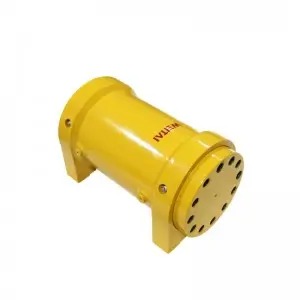
WEITAI L30 Series for Drilling and Mining Equipment
For heavy rotating mechanisms, the WEITAI L30 Series provides 180-degree and 360-degree hydraulic rotary actuator configurations.
The series offers torque options from approximately 1,900 Nm to 24,000 Nm, allowing it to support different sizes of drill positioning structures, pipe-handling arms, rotating attachments, and mining equipment mechanisms.
Available configurations can include:
- Foot-mounted housing
- Front-flange or double-flange output
- Cantilever or straddle mounting
- Optional counterbalance valves
- Customized hydraulic ports
- Application-specific rotation angles
- OEM and ODM dimensional matching
The actuator configuration can be developed according to the required torque, load position, mounting structure, operating pressure, rotation speed, and environmental conditions.
The L30 Series can also be evaluated as an interchangeable option for selected HELAC, HKS, and MOVECO rotary actuator applications. Actual replacement requires verification of mounting dimensions, output flange, torque, hydraulic interface, and load capacity.
Conclusion
A hydraulic rotary actuator for drilling equipment can provide a compact and direct solution for positioning drill masts, drilling attachments, pipe-handling arms, and other heavy rotating structures.
Compared with a cylinder-and-linkage arrangement, it can reduce external components, shorten the force-transfer path, and simplify installation in restricted spaces. Its ability to combine rotary drive and load support is especially useful in mining equipment exposed to heavy off-center loads, vibration, and repeated positioning cycles.
Reliable operation depends on correct torque selection, load analysis, mounting support, hydraulic control, rotation angle, and counterbalance protection. When these factors are matched to the real drilling conditions, the WEITAI L30 Series can support stable positioning and efficient rotary movement in demanding mining applications.
Frequently Asked Questions
Can a rotary actuator be used to position a drill mast?
Yes. It can rotate the drill mast between working, transport, or angled positions, provided that the actuator torque and load capacity match the mast structure.
Why is load position important when selecting the actuator?
A load positioned far from the rotation axis creates a greater overturning moment. Selection must consider both the weight and the distance between the load center and the actuator.
Is a counterbalance valve needed for an inclined drill mast?
It is often recommended when gravity could cause the mast to rotate uncontrollably. The valve helps control movement and hold the load when hydraulic flow stops.
Should a drilling mechanism use a 180-degree or 360-degree actuator?
The correct choice depends on the required movement range. Limited positioning normally uses 180 degrees, while complete rotation or multi-side access may require 360 degrees.
Post time: Jul-30-2026