
A Power Tilt upgrade is easy to describe as “adding tilt.” In practice, the more important change is what happens around that movement: how often the machine needs to reposition, how much hardware sits between the excavator and attachment, how the coupler is retained, and what happens when service is eventually required.
For excavator manufacturers and attachment suppliers, that makes a Before/After comparison more useful than simply comparing maximum tilt angles. Here is what the upgrade can look like when a conventional tilt arrangement is replaced by an integrated WEITAI Hydraulic Tilt Coupler solution.
1. Machine Positioning & Productivity
BEFORE: The Attachment Angle Often Dictates the Machine Position
With a fixed coupler or a less flexible attachment setup, the operator frequently has to position the entire excavator around the required working angle. On grading, ditch cleaning, slope shaping, and work close to obstacles, that can mean repeated machine movements between productive passes.
The limitation is not that the excavator cannot do the job. It is that more of the job depends on where the whole machine is sitting.
AFTER: Adjust the Attachment Instead of Repositioning the Excavator
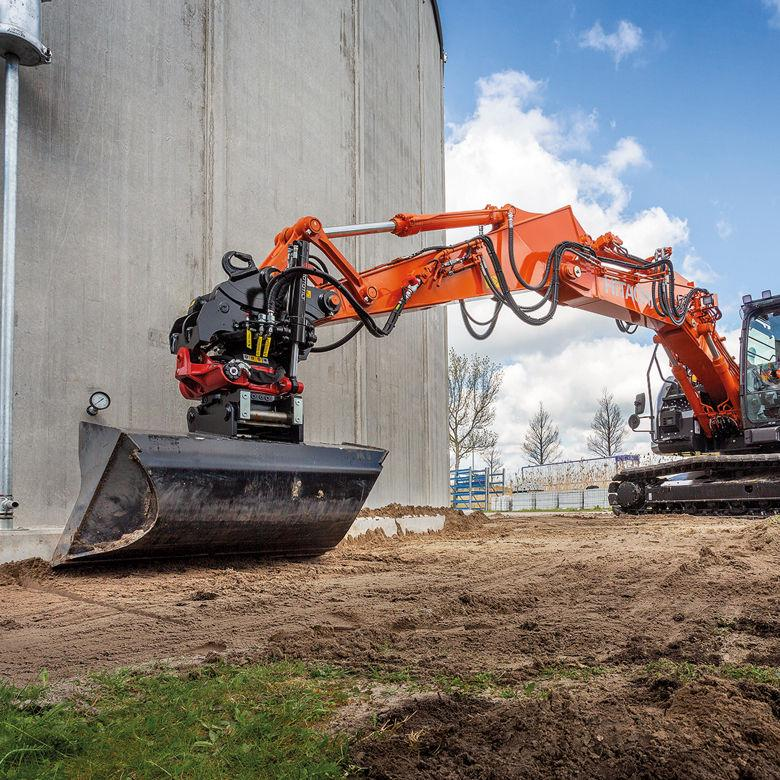
A Power Tilt coupler changes that relationship. With up to 180° total tilt, the attachment can work across a much wider range of angles from the same machine position.
For the operator, the benefit is straightforward: the bucket or attachment can follow the work more closely. For the machine manufacturer, the value is broader working flexibility without moving all the way to a more complex tiltrotator system.
2. Hydraulic & Mechanical Architecture
BEFORE: More External Components, More Packaging to Manage
Traditional tilt arrangements can involve separate motors, reducers, bearings, or external drive components. Each additional element takes up space, affects packaging, and introduces another interface that has to be considered during integration and service.
For an OEM, this becomes especially relevant when the goal is to add tilt functionality without unnecessarily increasing the distance between the stick and attachment.
AFTER: Integrated Helical Rotary Actuator Architecture
WEITAI’s Hydraulic Tilt Coupler uses an integrated helical rotary actuator as the core tilting mechanism. The actuator is built into the Power Tilt structure rather than relying on a bulky external motor-and-reducer arrangement.
The result is a more compact architecture with fewer external drive elements. It is not simply a different way to create rotation; it changes how the complete Power Tilt package can be integrated into the excavator.
3. Attachment Safety & Retention Logic
BEFORE: Safety Can Depend Too Heavily on the Hydraulic System
On any hydraulic coupler, attachment retention deserves the same attention as movement. A design that relies only on hydraulic pressure leaves an obvious question: what provides retention if pressure is lost?
For OEM evaluation, this is a more meaningful question than whether the coupler is simply described as “hydraulic.”
AFTER: Hydraulic Locking Plus Mechanical Retention
The WEITAI Power Tilt Coupler uses a dual-safety approach: an active hydraulic locking mechanism is supported by a passive mechanical anti-drop structure.
The two functions address different parts of the retention problem. Hydraulic power controls normal locking operation, while the mechanical structure adds another layer of protection. For a machine builder, that gives the locking architecture a clearer safety logic.
4. Maintenance & Total Cost of Ownership
BEFORE: Service Can Turn Into a Complete-Assembly Decision
The purchase price of a Power Tilt unit is visible on day one. Service cost appears later.
When a tilt assembly contains multiple external transmission elements or is difficult to separate into serviceable sections, a worn component can turn into a larger repair decision than it needs to be. That matters even more when machines are supported through a dealer network.
AFTER: A More Modular Approach to Service
WEITAI’s Power Tilt architecture is designed around serviceable actuator or module components, so maintenance does not automatically mean treating the entire assembly as a single replacement item.
This approach can simplify parts planning and reduce unnecessary replacement work. It also gives OEMs and distributors a more practical service story to carry through to the end user.
Conclusion: From a Single Component to an Integrated System
The Real Upgrade: From a Component to a Better Working System
The strongest case for upgrading a tilt solution is not one isolated specification. It is the combination of working range, compact integration, attachment retention, hydraulic protection, and serviceability.
That is also why Power Tilt selection should start with the excavator rather than a catalogue model number. Machine weight, pin diameter, dipper width, pin center, hydraulic requirements, and attachment interface all affect the final configuration.
For excavator manufacturers and attachment suppliers, the goal is not simply to add another moving joint. It is to add useful working flexibility without making the machine unnecessarily complicated.
CTA: Planning a Power Tilt Upgrade?
Send WEITAI your excavator model, machine weight, mounting dimensions, attachment interface, and required tilt range. Our engineering team can evaluate the appropriate WEITAI Hydraulic Tilt Coupler configuration for your application.
Post time: Sep-07-2026