
In construction machinery, special-purpose vehicles, and mobile hydraulic equipment, many movements are not simple linear extensions. Instead, the mechanism must rotate through a controlled angle while generating high torque within limited installation space.
For these applications, the rotary actuator must do more than simply make a component turn. It needs to start smoothly under load, maintain stable motion as the load changes, and hold the mechanism securely after rotation stops. A 5000 Nm Helical Hydraulic Rotary Actuator is well suited to this type of high-torque, limited-angle, compact rotary application.
Rather than focusing only on maximum torque, it is more useful to understand the relationship between drive torque, holding torque, radial load, axial load, and moment load. Together, these factors determine how a rotary actuator performs in real equipment.
What Does 5000 Nm of Drive Torque Actually Solve?
A 5000 Nm helical hydraulic rotary actuator can provide substantial rotary output under hydraulic pressure, allowing the mechanism to overcome its own weight, internal friction, and external resistance.
However, required torque cannot be judged only by the weight of the rotating component.
For example, a relatively light mechanical arm may still create a large rotational load if its center of gravity is positioned far from the rotation axis. On the other hand, a heavier structure mounted close to the center of rotation may require less torque.
This is why high-torque rotary actuators are commonly used in:
- Construction machinery attachments
- Heavy arm positioning systems
- Material-handling mechanisms
- Special vehicle working equipment
- Agricultural rotating attachments
- Mobile platform angle control
These applications usually do not require continuous high-speed rotation. Instead, they need strong rotary force over a limited angle together with stable positioning.
Why Is Holding Torque as Important as Drive Torque?
Many rotary mechanisms continue to carry load after movement stops.
A mechanical arm may remain under its own weight after reaching a working angle. An attachment may continue pressing against material. A tilted platform may still generate reverse torque around the rotation axis.
This means the actuator’s job does not end when the rotation stops.
Higher holding torque helps keep the mechanism stable when it must:
- Remain at a fixed angle for an extended period
- Carry an offset load
- Continue working in an inclined position
- Operate under machine vibration
- Resist external force after stopping
If an actuator has enough drive torque but insufficient holding capability, it may reach the required position but struggle to remain stable under load.
Rotary Torque Is Not the Only Load in Real Equipment
Once installed in a machine, the rotary actuator usually experiences structural loads from several directions.
Radial Load
Radial load acts perpendicular to the rotation axis.
For example, when an attachment is mounted to one side of the actuator, its own weight creates radial force. If the attachment is long, the distance from its center of gravity to the rotation axis can further increase the load on the rotary structure.
Axial Load
Axial load acts along the rotation axis.
When the connected mechanism experiences pushing, pulling, or axial impact, the actuator bearings and internal support system must absorb this force.
Moment Load
Moment load is mainly related to the offset distance of the working load.
Even if the attachment itself is not extremely heavy, a large distance between the load center and the actuator can create a significant bending effect. In heavy attachments and long mechanical arms, moment load may be more important than the total weight itself.
For this reason, a high-torque hydraulic rotary actuator should not only provide rotary output but also offer suitable radial, axial, and moment-load capacity.
Why Is Limited-Angle Rotation Suitable for Construction Machinery?
Mobile machinery does not always require continuous 360-degree rotation.
Many working mechanisms only need to move from one position to another or repeatedly operate within a fixed angular range, such as:
- Side-to-side attachment movement
- Platform angle adjustment
- Heavy door opening and closing
- Mechanical arm positioning
- Folding and unfolding working structures
- Switching between transport and working positions
For many of these applications, a rotation range of around 200 degrees is already sufficient.
A limited-angle design can also reduce the need for more complicated rotary seals, hose routing, and continuous-rotation interfaces, helping keep the hydraulic rotary mechanism compact.
How Does the Helical Design Reduce External Linkages?
A conventional hydraulic cylinder produces linear motion. If the final machine movement needs to be rotary, additional arms, pins, linkages, or pivot structures are usually required to convert linear travel into angular movement.
This method is widely used, but it takes up space and adds external moving parts.
A Helical Hydraulic Rotary Actuator performs the conversion internally.
Hydraulic pressure moves an internal piston, while the helical gearing converts the piston’s axial movement into rotary output. The rotary force is therefore generated directly around the required axis.
This structure can reduce the need for:
- Long external hydraulic cylinders
- Large rocker arms
- Multi-stage linkages
- Additional pins and pivot points
- Separate rotary support mechanisms
For construction machinery, mobile equipment, and special-purpose vehicles, this makes it easier to create a compact rotary system close to the actual working point.
Why Is High-Cycle Operation More Demanding?
Some mechanisms only rotate a few times per day.
Others, such as construction attachments, material-handling devices, and automated mobile equipment, may repeat the same movement hundreds of times during one working cycle.
In this situation, long-term consistency becomes more important.
A complete operating cycle may include acceleration, loaded rotation, deceleration, holding, and reverse rotation.
Repeated operation continuously affects:
- Helical gear contact
- Bearing support
- Internal sealing
- Hydraulic pressure stability
- Reversing shock
- Positioning consistency
For high-cycle applications, the question is not simply whether the actuator can rotate. More importantly, the speed, position, and load response should remain relatively consistent from one cycle to the next.
What Equipment Is Suitable for a 5000 Nm Helical Hydraulic Rotary Actuator?
A 5000 Nm hydraulic rotary actuator is generally suitable for medium-to-high load equipment that requires limited-angle rotation and has clear restrictions on installation space.
Typical applications include:
- Construction machinery attachments
- Material-handling equipment
- Special-purpose vehicle mechanisms
- Heavy positioning arms
- Agricultural machinery attachments
- Hydraulic platforms
- Industrial rotating frames
- Mobile equipment positioning systems
These machines may serve very different purposes, but their core requirements are similar: they need relatively high rotary torque without relying on large and complicated external transmission systems.
Why Can a Rotary Actuator Also Support Structural Loads?
In many machines, the rotary actuator is not only a power component. It also forms part of the rotating connection itself.
The attachment connected to the output side may create weight, impact, offset loading, and vibration. These forces are transferred through the rotary structure.
A rotary actuator used in heavy-duty equipment therefore needs to consider:
- Torque required to drive rotation
- Holding capability after movement stops
- Radial load created by attachment weight
- Axial load caused by pushing or pulling
- Moment load created by offset installation
This is also an important difference between a helical hydraulic rotary actuator and a conventional hydraulic motor. A hydraulic motor mainly produces rotary power, while a helical rotary actuator can also form part of the structural support at the rotation point.
WEITAI Helical Hydraulic Rotary Actuator
WEITAI helical hydraulic rotary actuators are used in construction machinery, special-purpose vehicles, agricultural equipment, and other mobile hydraulic systems requiring limited-angle rotation.
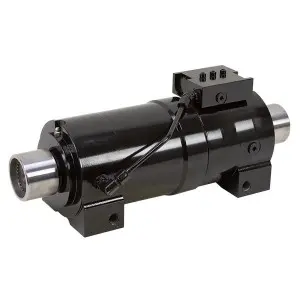
The 5000 Nm class uses a compact integrated structure that provides high rotary output while also supporting position holding and combined structural loads.
The actuator can use a foot-mounted arrangement with shaft or spline output, allowing it to connect with different machine structures.
Different torque levels are also available for applications ranging from moderate to heavier rotary loads, so the actuator can be matched to the actual operating condition instead of simply selecting the highest torque rating.
Conclusion
A 5000 Nm Helical Hydraulic Rotary Actuator is suitable for mobile machinery and industrial equipment that requires high torque, limited-angle rotation, and the ability to carry structural loads.
Its function is not limited to producing rotation. Drive torque determines whether the mechanism can move, holding torque affects stability after stopping, while radial, axial, and moment-load capacity influence how the actuator performs with real attachments and machine structures.
The helical design converts hydraulic linear motion into rotary output inside a compact housing, reducing the need for large external linkages, rocker arms, and transmission components.
For construction machinery, special-purpose vehicles, and mobile equipment, this provides a more compact way to achieve controlled high-torque rotation.
Frequently Asked Questions
What applications are suitable for a 5000 Nm Helical Hydraulic Rotary Actuator?
It is suitable for construction attachments, mechanical arms, mobile platforms, material-handling mechanisms, special-purpose vehicles, and other equipment requiring high-torque limited-angle rotation.
Does 5000 Nm directly correspond to a fixed load weight?
No. Required torque also depends on the distance between the load and the rotation center. The same weight can create very different torque demands at different mounting distances.
Why is limited-angle rotation suitable for many machines?
Many construction machines only need repeated movement within a fixed angular range. Limited-angle rotation can meet this requirement while keeping the overall structure more compact.
How is a helical hydraulic rotary actuator different from a hydraulic motor?
A hydraulic motor is mainly used for continuous rotary output. A helical hydraulic rotary actuator is better suited to limited-angle, high-torque movement and can also contribute to position holding and structural load support.
Post time: Aug-11-2026