
A 90 Degree Hydraulic Rotary Actuator can reach its commanded position without the connected valve achieving proper shutoff. The actuator may complete its rotation and send a closed-position signal, yet an incorrect stop setting, loose coupling or damaged valve seat can prevent the intended result. For marine and industrial valve-control systems, reliable operation requires more than confirming the actuator’s rotation angle. The mechanical connection, valve movement and hydraulic control must work together.
What Does a Closed-Position Signal Actually Confirm?
Remote valve-control systems often use limit switches or position indicators to show whether a valve is open or closed. These signals are important when valves are located in machinery spaces, below decks or other areas where direct observation is difficult.
However, a position indicator only confirms the movement measured by its sensing arrangement. If it is connected to the actuator rather than directly monitoring the valve closure element, it may indicate that the actuator has reached its target position without proving that the valve is fully sealed.
The valve may also reach its intended angular position while allowing fluid to pass because of worn seats, contamination or internal damage. Position feedback and shutoff performance are therefore different measurements.
For critical isolation applications, the required shutoff condition should be verified through an appropriate valve or system test rather than relying solely on the actuator’s position signal.
Where Can Movement Be Lost Between the Actuator and Valve?
A hydraulic rotary actuator transmits torque to the valve through a mechanical interface that may include a shaft coupling, mounting flange and associated fasteners. These components must maintain alignment while transferring the required operating torque.
A loose or worn coupling can introduce backlash, allowing part of the actuator’s movement to occur without the same movement at the valve stem. Incorrect coupling dimensions or mounting misalignment may also create additional friction and uneven loading.
This can produce a confusing situation: the hydraulic actuator appears to function normally, but the valve responds inconsistently. Increasing hydraulic pressure may not correct the problem and can place additional stress on the damaged connection.
The mechanical interface should therefore be checked before assuming that the actuator itself lacks sufficient torque.
Why Mechanical Stops Need Careful Adjustment
Quarter-turn valves commonly use approximately 90 degrees of stem rotation, but the exact operating positions must follow the valve manufacturer’s requirements.
If the actuator reaches its stop before the valve reaches the intended closed position, the valve may remain partially open. If the actuator attempts to rotate beyond the valve’s permitted travel, excessive torque can be transferred into the stem, coupling or internal stop components.
The correct stop setting should allow the valve to reach its specified operating position without forcing the mechanism beyond its design limits.
This is particularly important during actuator replacement. Two products may both be described as 90-degree actuators while having different adjustable-stop arrangements or shaft connections.
What Different Valve Symptoms Suggest
The relationship between actuator movement and valve response helps narrow the problem.
|
Observed Symptom |
Possible Cause |
What to Check |
|
Closed signal appears, but fluid still passes |
Incorrect stop position or valve-seat problem |
Actual stem position and shutoff condition |
|
Actuator rotates but stem movement is inconsistent |
Coupling wear or looseness |
Shaft and coupling interface |
|
High pressure is needed to start movement |
Breakaway resistance or hydraulic restriction |
Valve torque and hydraulic supply |
|
Movement slows near closure |
Increasing seating resistance |
Available closing torque |
|
Shock occurs at the end of travel |
Excessive speed or stop impact |
Flow control and stop arrangement |
|
Local operation works but remote operation fails |
Control-signal or hydraulic-circuit problem |
Remote-control system |
This separates faults involving the actuator, the mechanical connection and the valve itself. These components may show similar symptoms but require different corrective actions.
Why the Final Part of Valve Travel Matters
The torque required to operate a quarter-turn valve can change throughout its movement. Seat friction and differential pressure may create high resistance when opening begins, while closing can require additional torque as the sealing surfaces engage.
The highest torque requirement depends on valve design and service conditions. Ball valves, butterfly valves and other quarter-turn valves can have different operating characteristics, especially when fluid forces act on their closure elements.
An actuator must supply the torque needed to complete the required movement without exceeding the permissible torque of the valve stem or mechanical connection.
This is why a valve that opens correctly may still struggle to close under operating pressure. The problem may not be actuator travel, but insufficient torque at the relevant part of the movement.
Closing Speed Can Affect the Piping System
The time required to close a valve can influence the behavior of the connected piping system. Rapid closure changes fluid velocity and, in some liquid systems, may create pressure transients.
Depending on the piping layout, flow conditions and fluid properties, these transients can produce vibration or additional mechanical stress. Slowing the actuator may reduce some of these effects, but excessively slow closure can conflict with the operating requirements of the system.
Hydraulic flow control should therefore provide the required operating time while avoiding unnecessary impact at the valve’s end positions.For remotely controlled valve networks, this becomes a system-level design consideration rather than simply a question of actuator speed.
What Should Happen If Hydraulic Power Is Lost?
A double-acting hydraulic rotary actuator normally uses hydraulic pressure to move in both directions. That does not automatically determine what happens to the connected valve when hydraulic pressure is lost.Some applications require the valve to remain in its last position. Others require a specified fail-open or fail-closed response, depending on the consequences of an unintended valve position.
Where a defined failure response is necessary, the complete hydraulic and mechanical control arrangement must provide it. A double-acting actuator should not be assumed to offer an automatic fail-safe function without the appropriate supporting system.
This distinction is particularly important for marine and offshore valve-control applications.
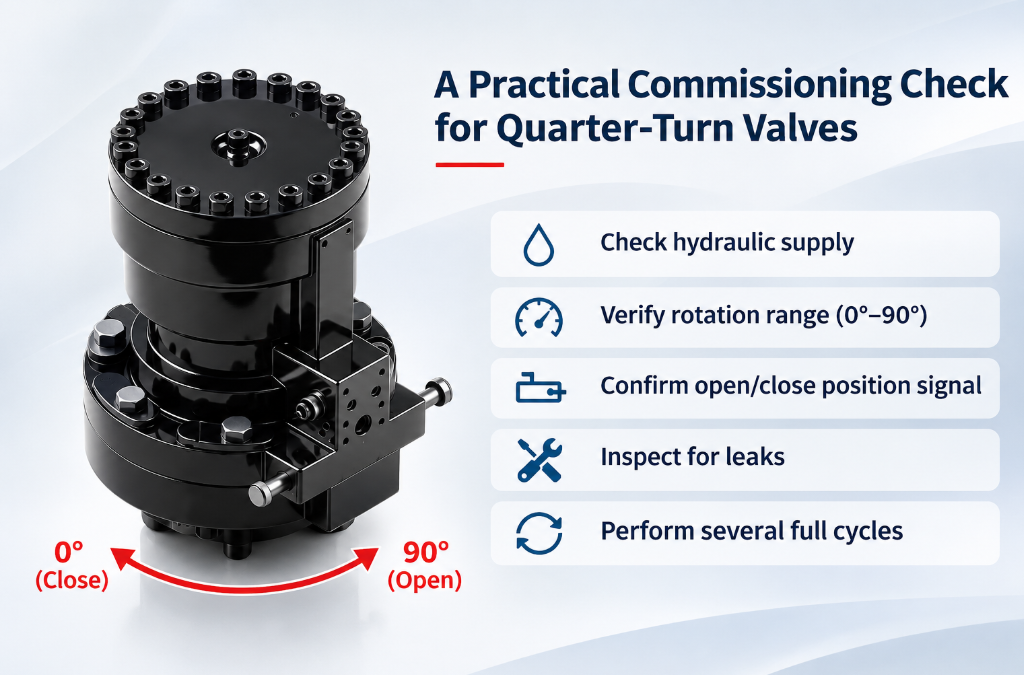
A Practical Commissioning Check for Quarter-Turn Valves
After installation, the actuator should be evaluated as part of the complete valve assembly.
● Confirm the specified valve rotation direction and operating positions.
● Check the mounting interface and shaft coupling for correct engagement.
● Adjust actuator stops according to the valve’s permitted travel.
● Verify opening and closing times under the required conditions.
● Compare remote position indication with actual valve movement.
● Confirm the required shutoff performance through appropriate testing.
● Verify the specified response to loss of hydraulic supply.
These checks help identify whether the system delivers the intended valve function rather than merely completing an actuator movement.
WEITAI WBRC Series for 90-Degree Valve Control
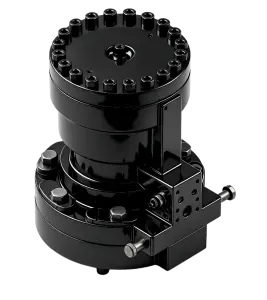
For marine and industrial quarter-turn valve applications, WEITAI offers the WBRC Series Hydraulic Valve Actuator, a double-acting balanced rotary actuator designed for 90-degree operation.
The WBRC Series uses a compact rotary-vane arrangement suited to valve remote-control applications. Its balanced design is intended to reduce unwanted side forces and bending moments at the valve interface.
The series can be considered for shipboard piping, ballast systems, cargo-handling equipment and industrial fluid-control installations where compact hydraulic valve operation is required.For OEM projects, WBRC actuator selection can be coordinated with valve torque requirements, mounting dimensions, hydraulic pressure and control-system design.
WBRC Replacement and OEM Supply
The WEITAI WBRC Series is also relevant to replacement projects involving BRC-type hydraulic valve actuators. However, a similar series designation or nominal rotation angle does not establish direct interchangeability.
A replacement must match the original mounting arrangement, shaft connection, hydraulic interfaces and required operating torque. Stop adjustment and control compatibility are equally important because the new actuator must operate the existing valve correctly.
WEITAI can evaluate OEM, replacement and wholesale requirements using the valve model, original actuator information and operating conditions. These details support the selection of a suitable WBRC configuration and quotation.
Conclusion
A 90 Degree Hydraulic Rotary Actuator must do more than rotate through a quarter turn. Its movement must reach the correct valve position, transfer torque through a reliable mechanical interface and satisfy the required operating and shutoff conditions.
For remote valve-control systems, the most useful performance measure is whether the complete valve assembly responds correctly—not simply whether the actuator reports that its movement is complete.
FAQ
Does a closed-position signal guarantee that a valve is sealed?
No. It may confirm actuator position without verifying the valve’s leakage performance. Shutoff must be checked separately where required.
Can the WEITAI WBRC Series replace a BRC-type actuator?
Potentially. Compatibility depends on mounting dimensions, shaft connection, hydraulic ports and operating torque.
How much does a 90 Degree Hydraulic Rotary Actuator cost?
90 Degree Hydraulic Rotary Actuator price depends on model, torque, materials, connections and control options. WEITAI provides project-based quotations.
Post time: Nov-23-2026