
A hydraulic rotary actuator for tilting couplers and a hydraulic cylinder linkage can both provide controlled attachment tilt, but they create this movement in very different ways. A hydraulic rotary actuator directly produces limited-angle rotary motion, while a hydraulic cylinder first creates linear push-pull movement and then converts it into rotation through links, pivots, and brackets.
For excavator attachment manufacturers, this difference affects far more than the tilt angle. It also changes the required installation space, overall coupler height, number of exposed moving parts, load path, maintenance approach, and the way the complete system is integrated at the end of the excavator arm. For OEM tilting coupler development, choosing between these two drive concepts can influence the entire product layout.
How Does a Hydraulic Cylinder Linkage Create Tilt?
A hydraulic cylinder linkage uses a conventional linear hydraulic cylinder as the power source. As the cylinder extends or retracts, the piston rod pushes or pulls a connecting arm. One or more pivots then convert this linear movement into angular motion of the tilting section.
This structure is relatively straightforward and offers considerable freedom in mechanical design. By changing the cylinder mounting position, linkage length, or pivot location, engineers can adjust the relationship between cylinder stroke and final tilt angle. For attachment products that already use a mature linkage layout, this remains a practical solution.
However, the cylinder itself is only one part of the complete mechanism. The system normally also requires pins, bushings, mounting brackets, connecting arms, and sufficient clearance for movement. Every additional pivot or connection needs to be considered in terms of structural strength, motion clearance, and protection in the working environment.
How Does a Hydraulic Rotary Actuator Produce the Same Movement?
A hydraulic rotary actuator uses a completely different motion principle. Hydraulic pressure enters the actuator and is converted directly into rotary torque, so there is no need to generate long linear travel first and then convert it into angular movement through an external linkage.
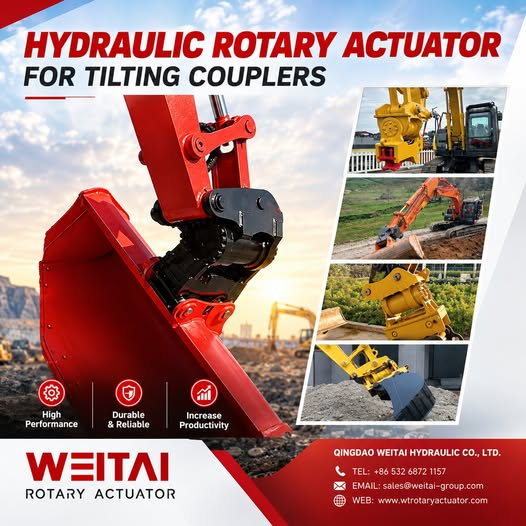
In a tilting coupler, the actuator can be installed directly around the required rotational axis and become part of the coupler structure itself. This allows both rotary movement and part of the load-support function to be concentrated into a more compact assembly without relying on multiple external linkage components.
This type of structure is particularly useful where space at the end of the excavator arm is limited. For OEM coupler design, reducing external components is not simply about appearance. It can also reduce the complexity of packaging the complete tilting mechanism.
Which Design Requires More Installation Space?
A hydraulic cylinder linkage needs enough room for both the cylinder body and the piston rod to extend and retract. At the same time, connecting arms must move around their pivot points, so clearance is usually required above, beside, or behind the main coupler structure.
When the coupler itself already has limited space, these external motion requirements can become an important design challenge. A compact cylinder does not automatically mean the complete linkage system will also be compact.
A hydraulic rotary actuator performs most of its movement internally and does not require the same external space for piston rod travel. Under similar tilt-angle and load requirements, this can make it easier to concentrate the rotary function within a smaller area.
This does not mean every rotary actuator design is automatically smaller. The actuator still needs sufficient diameter, mounting space, and hydraulic connections. The main advantage is that less additional space is needed to convert linear motion into rotation.
Why Does Overall Coupler Height Matter?
Any structure added between the excavator arm and bucket changes the original attachment position.
If a hydraulic cylinder linkage requires tall brackets or additional height for the linkage arrangement, the distance between the bucket and the original mounting point can increase. This not only changes the overall dimensions but can also affect bucket tooth position and the load moment acting on the attachment system.
For a tilting coupler, overall height is therefore more than a packaging issue. It becomes part of the working geometry at the end of the excavator arm.
A hydraulic rotary actuator can remove some of the external conversion components, making it easier to concentrate the rotational axis and drive mechanism into a more compact structure. This can be valuable for OEM products that need to add tilt while minimizing changes to the original bucket position.
How Do the Two Designs Transfer Load?
In a hydraulic cylinder linkage system, external bucket loads are usually transferred step by step through the coupler body, connecting arms, pivots, pins, brackets, and cylinder mounting points. Each component carries a different type and level of load.
Because linkage geometry changes as the coupler tilts, the actual force required from the hydraulic cylinder also changes throughout the movement. Some positions may provide better mechanical advantage, while others may require much higher cylinder force.
A hydraulic rotary actuator transfers load more directly around the rotational axis. Attachment torque and structural loads are mainly carried through the rotary output, actuator housing, mounting interface, and coupler body.
During excavation and grading, the tilting mechanism may need to handle several types of load at the same time:
- Rotary torque created by attachment operation;
- Radial loads transferred through the bucket and coupler;
- Axial loads along the connection direction;
- Moment loads created when the working point is offset from the rotational center;
- Dynamic loads generated when the bucket contacts the ground or changes direction.
For this reason, neither design should be evaluated from only one value such as cylinder force or actuator torque.
How Do the Two Designs Differ in Exposed Moving Parts?
A hydraulic cylinder linkage naturally has more exposed moving points. The piston rod repeatedly extends and retracts, pins and bushings rotate, and connecting arms change position as the coupler tilts.
This does not mean the design is unsuitable, but it does increase the number of working interfaces exposed to soil, stones, impact, and construction debris.
A hydraulic rotary actuator concentrates more of the movement inside an enclosed structure. The coupler still requires necessary rotating connections, but a long piston rod and multiple external linkage arms are no longer needed to generate the tilt motion.
For excavator attachments that operate continuously around soil, rock, and debris, reducing exposed moving components can simplify the layout and protection of the tilting mechanism.
How Do Maintenance Requirements Differ?
One advantage of a hydraulic cylinder linkage is that many wear points are easy to inspect visually. Loose pins, worn bushings, rod damage, bracket deformation, or external cylinder leakage can often be identified during routine inspection.
At the same time, there are more individual components to maintain. Pins, bushings, linkage joints, brackets, cylinder mounts, and piston rod surfaces can all wear over time.
A hydraulic rotary actuator reduces some of these external linkage points, so maintenance attention is more concentrated on actuator mounting, hydraulic connections, seals, rotary output condition, and the surrounding structure.
|
Design |
Main Inspection Areas |
|
Hydraulic cylinder linkage |
Piston rod, pins, bushings, links, brackets, and cylinder seals |
|
Hydraulic rotary actuator |
Mounting interface, hydraulic connections, seals, and rotary output condition |
There is no absolute answer to which design is easier to maintain. One emphasizes individually serviceable mechanical components, while the other focuses on a more integrated tilting unit with fewer exposed moving parts.
Is One Structure Always Better?
No single structure is suitable for every tilting coupler.
If there is sufficient installation space, the cylinder linkage is easy to protect, and the existing product already uses a mature cylinder-linkage design, continuing with a hydraulic cylinder solution may be the most direct approach.
If the project places greater emphasis on compact installation, fewer exposed linkages, direct rotary output, and a higher level of structural integration, a hydraulic rotary actuator becomes more attractive.
The more useful comparison is therefore not whether one technology is universally better, but how each structure changes the final tilting coupler design.
What Should Be Reconsidered When Changing From a Cylinder Linkage to a Rotary Actuator?
For a tilting coupler already designed around a hydraulic cylinder linkage, changing to a hydraulic rotary actuator is normally a structural redesign rather than a simple component replacement.
The two mechanisms use different rotational centers, mounting methods, and load paths, so the original brackets and linkage layout usually need to be reconsidered.
Important conditions include:
- Available installation space inside the existing coupler;
- Whether overall structure height needs to be reduced;
- Required tilt angle and rotational axis position;
- Excavator size and attachment weight;
- Actual working torque and additional structural loads;
- Existing hydraulic pressure, flow, and connection arrangement.
Once these conditions are clear, it becomes possible to determine whether an existing standard rotary actuator can be used directly or whether the mounting interface and configuration need to be adapted to the coupler structure.
How Does WEITAI Support Hydraulic Rotary Actuator Tilting Coupler Projects?
WEITAI provides helical hydraulic rotary actuators and Power Tilt solutions for construction machinery and excavator attachments. These products can be used for new OEM tilting coupler development, as well as for structural upgrades, actuator replacement, and alternative solutions for existing coupler products.
For new projects, the actuator can be matched according to coupler structure, excavator size, target tilt range, hydraulic system, and attachment load. If an existing coupler drawing or product structure is already available, the solution can also be evaluated around the available installation space and connection method.
WEITAI can support:
- OEM hydraulic rotary actuator integration for tilting couplers;
- Power Tilt product development;
- Replacement and alternative solutions for existing rotary actuators;
- Product matching for different excavator sizes;
- Batch attachment projects and long-term product supply.
For attachment manufacturers looking to move from a traditional cylinder-linkage structure to a more compact rotary solution, the actuator can be considered from the complete coupler design stage instead of being selected only after the coupler has already been finalized.
Conclusion
A hydraulic rotary actuator for tilting couplers and a hydraulic cylinder linkage can both provide angular movement for excavator attachments, but they result in significantly different overall coupler structures.
A hydraulic cylinder linkage uses familiar linear hydraulic components and provides flexible mechanical geometry, but it requires more pivots, brackets, connecting arms, and space for cylinder movement. A hydraulic rotary actuator directly produces angular motion, which can reduce external motion-conversion components and increase structural integration.
For OEM coupler development, the real comparison should not be limited to tilt angle. Installation space, overall height, load path, maintenance approach, hydraulic conditions, and the required level of structural compactness all need to be considered.
If a project requires a hydraulic rotary actuator quotation, OEM customization, existing actuator replacement, Power Tilt integration, or wholesale supply, WEITAI can match the actuator configuration according to the existing coupler structure and actual excavator application.
FAQ
Is a hydraulic rotary actuator always more compact than a hydraulic cylinder linkage?
In many designs, a hydraulic rotary actuator can reduce the space required for piston rod travel and external connecting arms, resulting in a more concentrated layout. However, the final size still depends on torque requirements, tilt range, load capacity, and the specific coupler structure.
Can an existing cylinder-type tilting coupler be redesigned around a hydraulic rotary actuator?
Yes, but this is normally a structural redesign rather than a direct component replacement. The rotational axis, mounting interface, coupler structure, hydraulic conditions, and attachment load all need to be confirmed again.
Can WEITAI provide alternatives to hydraulic rotary actuators from other brands?
Replacement can be evaluated, but the original actuator’s mounting interface, rotation range, working torque, hydraulic connections, and available installation space need to be compared. Similar external dimensions alone do not confirm interchangeability.
How Is the Price of a Hydraulic Rotary Actuator Project Determined?
Pricing usually depends on actuator size, torque requirements, rotation range, mounting arrangement, hydraulic configuration, customization requirements, and project quantity. For OEM or replacement projects, the actual application and corresponding configuration should normally be confirmed before a quotation is prepared.
Post time: Oct-26-2026