
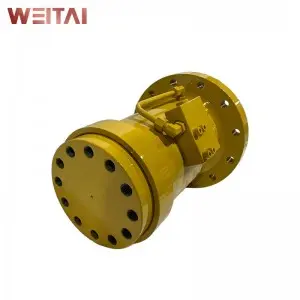
A Hydraulic Rotary Actuator for Drilling Machine is mainly used in drilling equipment where limited-angle rotation, positioning or mechanism adjustment is required. Unlike a hydraulic motor designed for continuous high-speed rotation, this type of actuator is better suited to controlled rotary movement within a defined angle while delivering relatively high torque in a compact installation space.
In drilling rigs, rock-drilling equipment and other mobile drilling machines, a Hydraulic Rotary Actuator for Drilling Machine may need to operate under limited space, frequent movement, vibration and existing hydraulic system constraints at the same time. Selection should therefore consider not only maximum torque, but also rotation angle, installation position, operating frequency and the mechanism actually driven by the actuator.
What Rotary Functions Can a Hydraulic Rotary Actuator for Drilling Machine Perform?
The most obvious rotary motion on a drilling machine is usually the continuous rotation of the drill string. However, many other mechanisms on the machine only require limited angular movement, such as drill-boom positioning, bracket swinging, auxiliary mechanism adjustment or angle changes at connecting structures.
These movements are different from continuous drill rotation. Hydraulic motors are better suited to continuous rotary operation, while a Hydraulic Rotary Actuator for Drilling Machine is more appropriate for repeated movement through 90°, 180° or another defined angle, with the mechanism remaining in the required position after movement.
If a conventional design uses a hydraulic cylinder, swing arm and linkage to create rotary movement, additional space is required for both cylinder stroke and linkage travel. In some drilling-machine mechanisms, a direct rotary actuator can reduce external moving parts and create a more compact rotary assembly.
Compact Installation Is Important in Drilling Equipment
A drilling machine usually combines drill booms, feed systems, hydraulic lines, supporting structures and multiple auxiliary mechanisms in a relatively limited space. As a result, the available installation envelope for a rotary actuator can be very restricted.
When a linear hydraulic cylinder is used to generate rotary movement through a linkage, space must be reserved not only for the cylinder body but also for cylinder extension and swing-arm travel. The moving mechanism must also remain clear of the machine frame, hoses and surrounding components throughout its full motion.
A compact Hydraulic Rotary Actuator for Drilling Machine can generate angular movement directly around the rotation axis. In suitable applications, this can reduce the space required by external linkages and make the rotary mechanism easier to integrate into drill-boom joints, auxiliary swing structures and other confined areas.
Rotation Angle Should Be Defined by the Machine Mechanism
Different drilling-machine mechanisms require different angular ranges. Some may only need 90° of movement, others may require 180°, while certain applications need another specific rotation angle based on the mechanical layout.
A larger rotation range is therefore not automatically better. If the mechanism only needs to move between a few defined working positions, excessive rotation may add installation and control complexity without improving machine performance.
For OEM projects, it is more practical to determine the required mechanical movement first and then select the corresponding rotary actuator. This allows actuator position, hose routing and surrounding structures to be designed around the real operating range instead of modifying the entire machine to fit an existing actuator.
Loads in Drilling Applications Are Not Constant
Drilling equipment often operates with vibration, shock and continuously changing mechanical loads. Even if the rotary actuator does not directly drive the drill bit, the drill boom or auxiliary mechanism connected to it may still receive dynamic loads transmitted through the machine during drilling.
For this reason, a Hydraulic Rotary Actuator for Drilling Machine should not be selected only according to the load measured in a static condition. Starting, stopping, reversing and machine vibration can all change the actual mechanical demand placed on the actuator.
If the actuator controls a long drill boom or another extended structure, the distance between the load and the rotation axis also becomes important. Two mechanisms with similar weight can create very different loads on the actuator when their working radii are different.
Frequent Positioning and Continuous Rotation Are Different Duties
Some auxiliary mechanisms on drilling machines do not rotate continuously. Instead, they repeatedly change angle during each operating cycle. The actuator may need to start, stop, hold position and reverse direction many times, creating a very different duty from a continuously rotating hydraulic motor.
In this type of application, torque alone is not enough. Motion smoothness, response speed and the ability of the hydraulic system to provide stable flow through repeated cycles also matter.
Selecting an actuator only because it has a higher maximum torque can result in slow movement, poor control coordination or an unnecessarily oversized hydraulic arrangement if the real operating frequency is ignored. Duty cycle should therefore be treated as part of rotary actuator selection.
The Hydraulic System Directly Affects Actuator Performance
The actual performance of a Hydraulic Rotary Actuator for Drilling Machine depends on the hydraulic conditions available from the host machine. System pressure influences available torque, while hydraulic flow affects rotational speed.
Drilling equipment usually operates several hydraulic functions at the same time, so the actuator should not be evaluated as if it had an independent hydraulic circuit. Available working pressure and usable flow need to be confirmed, especially when other functions may operate simultaneously.
Hydraulic ports and hose routing should also be considered early. If the actuator is mounted on a moving drill boom or swing mechanism, the hoses must follow the full movement without excessive stretching, crushing or bending.
What Information Should Be Confirmed for a Hydraulic Rotary Actuator for Drilling Machine?
A drilling-machine rotary actuator project should not begin with a torque value alone. The actual machine movement and installation conditions usually provide a more reliable basis for selection.
Recommended project information includes:
● Drilling machine or equipment type
● Mechanism driven by the actuator
● Required rotation angle
● Weight and approximate dimensions of the driven structure
● Working distance between the load and rotation axis
● Available installation space and mounting dimensions
● Hydraulic system pressure and flow
● Operating frequency and duty cycle
This information helps determine the required rotary capacity, whether the actuator can physically fit the machine and whether the hydraulic system can support the expected movement.
OEM Drilling Projects and Replacement Projects Have Different Priorities
In a new drilling machine or newly developed mechanism, the rotary actuator can be integrated during the early design stage. Rotation-axis position, mounting interfaces, drill-boom geometry and hydraulic routing can all be coordinated together, giving OEM projects greater design flexibility.
Replacement projects are different because the existing machine structure already defines most of the available space and interfaces. The new actuator must reproduce the required motion while fitting the existing mounting arrangement and hydraulic system as closely as possible.
The two project types have the same objective—matching the actuator to the machine—but follow different paths. OEM projects focus on integrating the actuator into a new mechanism, while replacement projects focus on minimizing modifications to the existing equipment.
WEITAI Hydraulic Rotary Actuator Solutions for Drilling Equipment
WEITAI provides hydraulic rotary actuators for construction machinery and mobile equipment, including applications that require limited-angle rotation, swinging and positioning in drilling equipment.
For drilling applications, it is generally more practical to begin with the real mechanical movement rather than simply selecting the actuator with the highest torque. Where an existing rotary actuator configuration already matches the required installation and performance, a standard actuator platform can provide the starting point.
If the drill-boom structure, rotation angle or available installation space creates special requirements, an OEM configuration can be evaluated based on the actual machine layout.
Conclusion
A Hydraulic Rotary Actuator for Drilling Machine is valuable because it can provide controlled limited-angle rotary motion within the restricted installation space commonly found on drilling equipment, while also supporting frequent positioning under changing loads.
The most important selection factors are not limited to maximum torque. Rotation range, machine geometry, installation space, duty cycle and host-machine hydraulic conditions all affect whether the actuator will work properly in the application.
For new drilling equipment, the actuator can be considered during the mechanism design stage. For existing-machine replacement, preserving the original mechanical and hydraulic interfaces is usually more important in order to reduce modification requirements.
FAQ
Is a Hydraulic Rotary Actuator for Drilling Machine suitable for continuously driving a drill bit?
Limited-angle hydraulic rotary actuators are generally better suited to swinging, positioning and angle adjustment. If the application requires continuous rotation for long periods, other rotary drive solutions such as hydraulic motors should be evaluated according to the actual duty.
Can the rotation angle of a drilling-machine rotary actuator be customized?
The available options depend on the actuator series and project requirements. For OEM applications, the required movement range can be evaluated to determine an appropriate rotation angle and configuration.
Can a WEITAI actuator replace another brand of rotary actuator?
A replacement or alternative solution can be evaluated, but compatibility should not be determined only by appearance or similar torque. Original mounting interfaces, rotation range and hydraulic conditions still need to be confirmed.
How should I choose between a standard and custom rotary actuator?
If a standard actuator already meets the installation space, rotation range and load requirements, additional customization may not be necessary. An OEM configuration becomes more relevant when existing products cannot match the machine structure or special operating conditions.
Post time: Nov-05-2026