
Holding torque for excavator attachments is a critical consideration when selecting a hydraulic actuator for a tilt coupler, tilting bucket or other rotary attachment. The actuator must not only rotate the attachment to the required angle but also maintain that position while attachment weight, bucket load and ground reaction forces continue to act on the mechanism.
This is especially important during grading, slope finishing and trench work, where the attachment may remain at one angle for much longer than it spends rotating. An actuator can have enough drive torque to move the attachment but still be unsuitable if it cannot resist external loads after the movement stops.
Drive Torque and Holding Torque Address Different Working Conditions
Drive torque describes the actuator’s ability to create rotary movement. When the operator changes the bucket angle, the actuator must overcome attachment weight, working radius and other resistance to move the mechanism into the required position.
Holding torque describes what happens after that movement stops. External forces are still acting on the bucket or attachment, and the actuator must resist the resulting moment to prevent unwanted rotation.
This distinction is important for tilt couplers. Selecting an actuator only because it can rotate the attachment does not confirm that it can keep the attachment stable during actual work.
Tilt Couplers Spend Much of Their Working Time Holding Position
A tilt coupler usually makes relatively short angular movements. The operator adjusts the bucket to the required position and then continues grading, trench cleaning or slope shaping while maintaining that angle.
During this stage, the actuator may remain stationary while the attachment continues to interact with soil, gravel or other material. Ground contact can continuously transfer force back through the bucket and tilt mechanism.
If the attachment shifts whenever the load changes, the operator has to repeatedly correct the angle. For finishing and grading applications, holding performance therefore affects both working stability and operating efficiency.
Attachment Weight Alone Does Not Determine Holding Torque
Attachment weight is important, but it does not fully describe the torque acting on the rotary actuator. The distance between the load and the actuator’s rotation axis also matters.
Two attachments can have similar weight but create very different torque demands. A longer bucket with its center of gravity farther from the rotation axis creates a larger moment than a shorter attachment of similar weight. Material inside the bucket can increase the effective load further, especially when the load is positioned far from the actuator.
Ground reaction forces create another variable. During digging, grading or pressing against a surface, the actuator may experience forces significantly greater than those created by the static attachment weight alone.For this reason, excavator tonnage and attachment weight should be treated as starting information rather than the only criteria for selecting a tilt actuator.
Working Angle Changes the Load on the Actuator
The torque acting on the actuator changes as the attachment moves through its working range. When the bucket angle changes, the center of gravity also changes position relative to the rotation axis, which changes the effective lever arm.
Some positions may create relatively low torque, while another position can place much greater demand on the actuator even though the attachment and payload remain the same. External reaction forces can also act from different directions during slope grading, trench work or other ground-contact applications.
For actuator selection, the most demanding realistic working position is therefore more useful than evaluating the attachment only in a neutral position.
Rotation Range Cannot Replace Proper Torque Matching
A 180°, 220° or larger rotation range describes how far the attachment can move. It does not describe how much load the actuator can hold at those positions.
A larger rotation range can provide more operating flexibility, but the additional angle has limited value if the actuator cannot maintain the attachment under load. Likewise, an actuator with high holding torque may not be useful if its available rotation does not cover the movements required by the machine.
Rotation angle should therefore be selected according to the required work envelope, while drive torque, holding torque and structural capacity should be evaluated according to the actual attachment load.
Structural Loads Matter in Addition to Holding Torque
A hydraulic rotary actuator installed directly in an excavator attachment can experience more than rotational torque. Depending on the attachment geometry and mounting arrangement, loads may also be transmitted as bending moments, radial loads and axial loads.
These ratings describe different mechanical conditions. An actuator may provide sufficient drive and holding torque but still be unsuitable if the attachment creates structural loads beyond its allowable capacity.
For heavy-duty applications, the actuator should therefore be considered as part of the full load path—from the bucket or tool, through the tilt mechanism and coupler, and into the excavator arm. This provides a more realistic basis for selection than comparing torque figures alone.
What Information Is Needed to Match a Tilt Actuator?
Excavator tonnage alone is rarely enough to determine the correct actuator. The attachment geometry, working condition and hydraulic system should also be considered.
Useful project information includes:
● Excavator tonnage or operating weight
● Attachment type and approximate weight
● Bucket or tool working radius
● Expected payload and working condition
● Required tilt or rotation range
● Available installation space and mounting dimensions
● Hydraulic pressure and flow
● Original actuator model for replacement projects
These details help distinguish between an actuator that simply fits into the available space and one that is actually suitable for the expected load.
Different Tilt Applications Require Different Actuator Designs
Actuators developed specifically for tilting couplers are not necessarily the same as general-purpose high-torque rotary actuators. A tilt coupler actuator is typically designed around controlled attachment tilting, position holding and the structural conditions found between the excavator arm and attachment.
General hydraulic rotary actuators can serve a wider range of equipment, including drilling machinery, construction attachments, agricultural equipment and other mobile mechanisms. These applications may require different rotation ranges, torque levels and structural load capacities.
If the project is specifically for an excavator tilt coupler, an actuator designed around that application is usually the more direct starting point. Broader high-torque actuator platforms become more relevant when the mechanism has different motion or load requirements.
WEITAI Actuators for Tilting Coupler Applications
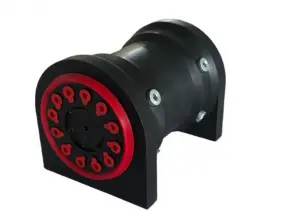
WEITAI’s WBV Series is designed for tilting coupler applications and offers different configurations for different excavator and attachment requirements. For these projects, holding torque can be evaluated together with excavator class, attachment geometry, working radius and required tilt range rather than selecting a product from one torque figure alone.
For applications requiring a broader high-torque rotary solution, the WL30 Series provides another option. Its specifications distinguish between drive torque, holding torque, moment capacity, radial capacity and axial capacity, allowing rotary performance and structural loading to be considered separately.
The WBV Series therefore provides a more direct direction for excavator tilting couplers, while WL30 is better suited to a wider range of high-torque mobile machinery and construction attachment applications.
OEM and Replacement Tilt Actuator Projects
For a new tilt coupler, confirming the actuator early in the design process allows mounting width, attachment geometry, rotation range and load path to be developed together. This reduces the need to modify the attachment structure after the main design has already been completed.
Replacement projects require a different approach because the existing attachment structure is already fixed. Mounting dimensions, hydraulic connections, rotation range, holding torque and structural load capacity all need to be checked before another actuator can be considered a replacement.
WEITAI can evaluate OEM and alternative projects based on an existing actuator model, drawing or attachment information. For OEM hydraulic tilt actuators, replacement tilt actuators, custom rotary actuators or batch supply, providing complete machine and attachment information can help confirm the configuration and quotation more efficiently.
Conclusion
Holding torque for excavator attachments determines whether a tilt mechanism can remain stable after reaching the required working angle. An actuator that can rotate a bucket successfully may still be unsuitable if it cannot resist the moments created by attachment weight, payload and ground reaction forces.
Working radius, load position, operating angle and structural loads all influence actuator requirements. For this reason, a tilt actuator should be selected according to the complete working condition rather than by excavator tonnage, rotation angle or one torque value alone.
For dedicated tilting coupler applications, the WEITAI WBV Series provides a direct product direction. For broader high-torque rotary applications requiring different structural load capacities and rotation requirements, the WL30 Series can also be considered.
FAQ
What is the difference between drive torque and holding torque?
Drive torque is the torque used to rotate the attachment. Holding torque is the actuator’s ability to resist external moments and prevent unwanted rotation after the attachment reaches the selected working position.
Is excavator tonnage enough to select a tilt coupler actuator?
No. Attachment weight, working radius, payload, operating angle, mounting structure and hydraulic conditions should also be evaluated. Two excavators in the same tonnage class can require different actuator capacities when using different attachments.
Can a tilt actuator from another brand be replaced?
Yes, an alternative or replacement solution can be evaluated. However, mounting dimensions, rotation range, holding torque, structural capacity and hydraulic interfaces should all be confirmed before compatibility is determined.
How can I get a quotation for a tilt actuator?
Provide the excavator size, attachment type, required tilt range, mounting dimensions, hydraulic pressure and flow, and expected order quantity. For a replacement project, the original actuator model or drawing can also help confirm a suitable configuration.
Post time: Nov-02-2026